


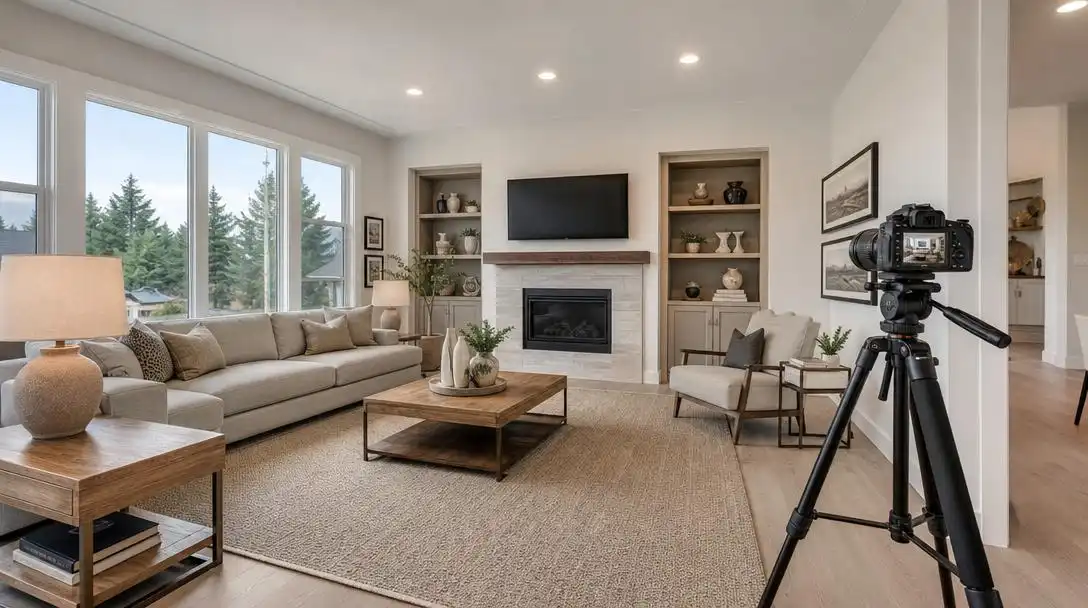
Search "real estate photography" and Google gives you three local businesses before it gives you a single article. That is not an accident. This is a local service market, and the top questions people ask alongside it are not about aperture settings. They are about money and survival: how much do real estate photographers make, how do I get into it, is it a good career, and will AI replace it.
This guide answers those questions in that order, because that is the order people actually ask them. It covers what the work involves in 2026, what the deliverable has become, what it costs to buy and what it pays to sell, and where AI has genuinely changed the economics rather than just the marketing copy.
We build Amplifiles, which turns listing photos into 1080p marketing videos in about five minutes at $1.50 per image (one dollar and fifty cents). That means we sell to both sides of this market, agents buying listing media and photographers producing it, and we see what each side actually pays for. Some of what follows will be uncomfortable for people selling photo-only packages. If you want the money question first, start with our breakdown of real estate photography pricing.
What is real estate photography?
Real estate photography is the practice of producing images of a property for the purpose of selling or renting it. It is commercial work with a deadline and a defined output, not artistic photography that happens to feature buildings. The client is almost always a listing agent, a brokerage, a property manager, or a homeowner preparing to sell.
The craft problem is specific and it has not changed: interiors have a brightness range that no camera sensor captures in one exposure. A room lit by a window is several stops brighter at the glass than it is in the corner. Solving that gap is the entire technical core of the job. Everything else, composition, verticals, staging, sequencing, sits on top of it.
Three approaches dominate, and photographers argue about them constantly. HDR real estate photography brackets multiple exposures and merges them, which is fast and forgiving but can look artificial if pushed. Flambient blends a flash frame with an ambient frame to get clean color and natural window views, which looks better and takes longer. Manual flash blending gives the most control and the slowest turnaround. Most working photographers pick one, get fast at it, and stop relitigating the choice.
What has changed is scope. A decade ago the deliverable was a folder of stills. In 2026 a typical listing package includes stills, a video or reel, sometimes a floor plan, sometimes aerials, and increasingly a virtually staged version of the empty rooms. The photographers doing well are the ones who noticed that shift. The ones struggling are still selling twenty-four photos for a flat fee and wondering why the number will not move.
What real estate photographers actually earn
This is the question the search data says people care about most, so here is a direct answer before the caveats.
Per-listing rates in North America typically run from about $150 for a small entry-level shoot to $400 and up for larger homes or premium packages, with commercial and luxury work sitting well above that. Rates vary enormously by metro. The same 2,000 square foot house pays differently in Austin than it does in a small midwestern market, and the local pack at the top of the search results is a fair proxy for how crowded your particular market is.
The number that matters is not the rate. It is the rate divided by total time. A shoot that pays $200 and takes ninety minutes on site plus two hours of editing is a $46 per hour business before you account for driving, scheduling, invoicing, equipment depreciation, insurance, and the listings that cancel. Photographers who track this honestly usually find that editing, not shooting, is where the margin goes. We go deeper on the full picture in how much real estate photographers make.
That local pack has a practical consequence most gear guides skip. If you are building a photography business, your Google Business Profile and your service area will move more revenue than your next lens purchase. Getting found locally is the constraint, not image quality. We cover the client side of that in how to get real estate photography clients.
The equipment question, answered briefly
Gear guides are the most written and least useful genre in this field, so here is the short version. You need a camera that shoots raw with reliable bracketing, a wide angle lens in the 16mm to 24mm full frame equivalent range, a sturdy tripod, and at least one flash if you intend to shoot flambient. That is the entire list of things that change your output.
The lens matters more than the body. A modern entry-level body with a good wide angle beats a flagship body with a kit zoom every time, because distortion control and corner sharpness are what show up in a 2,000 pixel wide MLS image. Our guide to the best lens for real estate photography covers the specific options, and the full equipment guide handles tripods, flashes, and the accessories that actually earn their bag space.
Two additions are worth considering once you are working steadily. Drone work opens up exteriors, lot context, and rooflines that ground level cannot show, and it commands a real premium. It also requires a Part 107 certificate in the United States. See real estate drone photography and video for what that involves, and real estate drone photography pricing for what to charge. Twilight shoots are the other high-value add, because they photograph well and sell well. Twilight real estate photography covers the window, which is shorter than most people expect. If agents ask for virtual tours, a 360 camera for real estate photography is a lighter entry point than a dedicated scanner.
How a listing shoot actually runs
The difference between a profitable shoot and an unprofitable one is almost always decided before the camera comes out of the bag.
- Confirm the property is ready. The single largest cause of blown margin is arriving to a house that has not been prepared. Send a prep list to the agent in advance covering clutter, cars in the driveway, toilet seats, pet bowls, and lights. An unprepared house adds an hour you will not bill for.
- Walk the property first. Five minutes deciding the shot order beats forty minutes of wandering. Identify the hero shot, the rooms that sell the house, and the ones that need the widest angle.
- Shoot to a fixed sequence. Exterior front, main living space, kitchen, primary bedroom, primary bathroom, secondary rooms, outdoor space, then any feature detail. Working the same order every time makes you faster and makes editing predictable. Our real estate photography shot list is the version to hand to a new shooter.
- Level everything. Vertical lines that converge are the fastest way to make a listing look amateur. Fix this on the tripod, not in post.
- Edit to a batch, not to a masterpiece. Consistency across a set matters more than perfection on any one frame. Buyers scroll the gallery in sequence and notice when the white balance jumps.
- Deliver fast. Turnaround is a competitive weapon. Next-morning delivery wins repeat agents more reliably than a marginally better edit does.
Build the prep list into your booking confirmation email so the agent sees it before the day arrives rather than when you are standing in the driveway.
What AI actually changed, and what it did not
This is where most guides either panic or reassure, and both are unhelpful. Here is our read, from the position of a company that builds the tooling.
AI collapsed the cost of the edit. It did not collapse the cost of the capture. Those are different halves of the job and they are moving in opposite directions.
Editing, sky replacement, straightening, color work, decluttering, and virtual furnishing have all gone from skilled manual labor to something close to a commodity. TechRadar reported on an Aftershoot survey of more than 1,000 professional photographers in which about 64% said their clients did not notice any difference in AI-edited work, which is an uncomfortable finding if editing is where you were adding value. Meanwhile someone still has to physically go to the house, at the right time of day, with the right lens, and make the exposure. No model does that.
The risk is not that photographers get replaced. The risk is the race to the bottom that follows when the expensive part of your service becomes cheap for everyone at once. PetaPixel has covered the visible end of this, reporting on agents using AI images in place of actual photos, where the imagery drifts from the property it is supposed to represent. That is the failure mode: not photographers losing work to AI, but the whole category losing credibility because the floor dropped.
The practical response is to move up the package rather than compete on price per photo. If AI does the editing anyway, sell the things it cannot do: showing up, knowing which twelve frames sell this specific house, and delivering a complete media set the agent can put straight to work. See AI real estate photo editing for where the tooling is genuinely good and where it still fails.
The 2026 listing media package
Here is the shift stated plainly. Photography is no longer the deliverable. It is the raw input to a media package, and the package is what agents pay for.
Every asset in a modern listing package starts from the same set of stills. That is the important structural fact, because it means the marginal cost of adding a second and third deliverable is now very low. The photographer already drove to the house. The photos already exist. Turning them into a listing video, a set of vertical social cuts, and a staged version of the empty rooms does not require a second visit.
Look at the first four rows. Four deliverables, one visit. That is the whole argument for repackaging. A photographer charging $200 for stills who adds a video and a set of vertical cuts from the same shoot is selling a $350 package for perhaps twenty extra minutes of work, because the production is software now rather than an edit suite. Turning real estate photos into video with AI walks through that specific workflow, and real estate photography packages covers how to structure the tiers. We also make the case that real estate photographers should include listing video in every order rather than upselling it.
Amplifiles produces a 1080p listing video from a set of stills in about five minutes at $1.50 per image, with voice-over, captions, and branding included. For a twelve image video that is $18 in production cost against a $75 to $200 add-on line item. That margin is the reason the package shift is happening, and it is available to any photographer who already owns the photos. If you would rather not build the videos yourself, Done-For-You has our human editors make them from your photos within 24 hours, from $39 per listing, and you resell them to your agents at your own price.
Where the tools fit: a comparison
Photographers building a media package usually end up choosing between three categories of tool, and they solve genuinely different problems. Naming them plainly is more useful than pretending one tool does everything.
Unlike BoxBrownie, which sends your images to human editors and returns edited stills, Amplifiles works on the motion layer and produces a finished video rather than a better photograph. Unlike Matterport, which requires a separate scan of the property with dedicated hardware, Amplifiles works from the photos you already took, so there is no second capture step. Lightroom remains the right tool for raw processing and batch consistency, and nothing here replaces it. Most photographers use two or three of these rather than one.
On staging specifically, AI virtual staging furnishes empty rooms from $0.20 per edit while leaving walls, floors, and windows untouched. Our guide to real estate virtual staging covers the disclosure rules, which matter: most MLS systems and many state regulations require you to label digitally staged imagery, and the requirements vary by region.
Best practices that survive contact with a real shoot
Most tip lists are interchangeable. These are the ones that repeatedly separate photographers who keep agents from photographers who lose them. For the longer checklist, see our real estate photography tips.
Sell turnaround, not megapixels. Agents rebook the photographer who delivers by 9am the next morning. They do not rebook based on sensor size. If you can compress delivery, do it before you upgrade anything.
Shoot fewer, better frames. Portals and buyers reward a tight, well-sequenced gallery over a comprehensive one. Twenty-five strong images beats forty that include the laundry room from three angles.
Fix the house, not the file. Two minutes moving a trash can out of frame saves fifteen minutes of cloning. This is the highest return habit in the job.
Standardize your white balance across the set. Gallery consistency is what reads as professional. A single warm frame in a cool set is more noticeable than any individual imperfection.
Price the package, not the photo. Per-photo pricing caps your revenue at the number of rooms in the house. Package pricing lets one visit produce several billable deliverables.
Disclose AI edits. Virtual staging, sky replacement, and added elements should be labeled. Beyond the compliance question, agents remember who protected them from a complaint. Our post on AI virtual staging disclosure laws covers the current landscape.
Build a portfolio that shows range, not volume. Agents are checking whether you can handle their listing type, not counting your images. Building a real estate photography portfolio covers what to include.
Starting a real estate photography business
If you are entering the field, the sequence that works is narrower than most advice suggests. Learn one exposure technique properly rather than sampling all three. Shoot ten houses for free or near free to build a portfolio and, more importantly, to find out how long the work actually takes you. Set a rate based on that measured time rather than on what a forum says. Then spend your marketing effort on local visibility and on two or three agents who list consistently, because repeat clients are the entire business model.
The economics reward specialization. Photographers who serve one property type well, whether that is mid-market residential, luxury, or commercial, tend to build referral flow faster than generalists. Our guides to starting a real estate photography business and real estate photography jobs cover the operational side, from contracts to pricing your first packages.
One honest caution. This is a local service business with a low barrier to entry and a visible local pack, which means competition is immediate and price pressure is real. The people who do well treat it as a business with a marketing problem rather than as a photography career. If you are picking between adding video to an existing photo business and starting from zero, the first is considerably easier.
Common questions about real estate photography
How much do real estate photographers make?
Per-listing rates in North America generally run from about $150 for a small entry-level shoot to $400 or more for larger homes and premium packages, with commercial and luxury work above that. Annual income depends far more on shoot volume and package size than on rate, since a photographer completing two listings a day with add-ons earns multiples of one completing three a week at the same base rate. Track your effective hourly rate including editing and travel, because that is the number that tells you whether the business works.
How do I get into real estate photography?
Learn one exposure technique properly, either HDR or flambient, then shoot ten properties to build a portfolio and measure how long the work takes you. Set your rate from that measured time, register a Google Business Profile so you appear in local results, and target two or three agents who list consistently rather than pitching broadly. Repeat clients are the business, so delivery speed and reliability matter more than portfolio polish.
How much should an agent pay for real estate photography?
For a standard residential listing, expect roughly $150 to $400 depending on square footage, market, and what is included. Ask specifically what the package covers, because the gap between a photo-only shoot and a full media package with video, vertical social cuts, and staging is where most of the price variation sits. An agent who wants video should ask whether it is produced from the stills, since that costs the photographer very little to add.
Will AI replace real estate photography?
AI has largely commoditized the editing half of the job, but not the capture half. Someone still has to visit the property, choose the time of day, frame the rooms, and make the exposures, and no current model does that. The realistic effect is margin compression for photographers who priced on editing labor, and expanded scope for those who now deliver video and staging from the same shoot.
Can I turn my listing photos into a video without filming?
Yes. Amplifiles turns a set of listing photos into a 1080p marketing video in about five minutes at $1.50 per image, with voice-over, captions, and branding, and no filming or editing software required. A typical twelve image listing video costs around $18 to produce. You can see finished output on the real estate video examples page.
Do I need a drone license for real estate photography?
In the United States, flying a drone for commercial purposes including real estate listings requires an FAA Part 107 remote pilot certificate. Rules differ in other countries, so check your national aviation authority. Drone work commands a genuine premium, so the certificate usually pays for itself quickly if you shoot exteriors regularly.
What lens should I use for real estate photography?
A wide angle in the 16mm to 24mm full frame equivalent range covers almost every interior situation. Going wider than 16mm introduces distortion that makes rooms look unnatural and tends to read as a red flag to buyers. Prioritize corner sharpness and distortion control over maximum aperture, since you will be shooting on a tripod at narrow apertures anyway.
Do I have to disclose virtually staged photos?
Usually yes. Most MLS systems and many state regulations require disclosure when listing imagery has been digitally staged or altered, and the specific wording and placement requirements vary by region. Common accepted labels include "virtually staged image" and "digitally staged for illustrative purposes." Check your local MLS rules, because enforcement and penalties differ.
Final Thoughts
Real estate photography is not a shrinking field, but it is a changing one. The technical craft of capturing a property well is as valuable as it ever was. The editing labor that used to justify a large share of the invoice is not. The photographers and agents who are doing well in 2026 responded to that by widening the deliverable rather than defending the old one, which is a better position than it sounds: one visit, one set of photos, and several things worth billing for.
We built Amplifiles because the photos for a great listing video almost always already exist, and the only thing standing between them and a finished video was editing time nobody had. Our platform turns listing photos into professional 1080p marketing videos in about 5 minutes, with voice-overs, captions, and branding. No filming or editing required.
Browse real estate video examples to see what a delivered listing video looks like before creating one. Or jump straight to how Amplifiles works for photographers and start with your 1,200 free credits, and check pricing if you want to model the margin on a package before you sell one.