.webp)


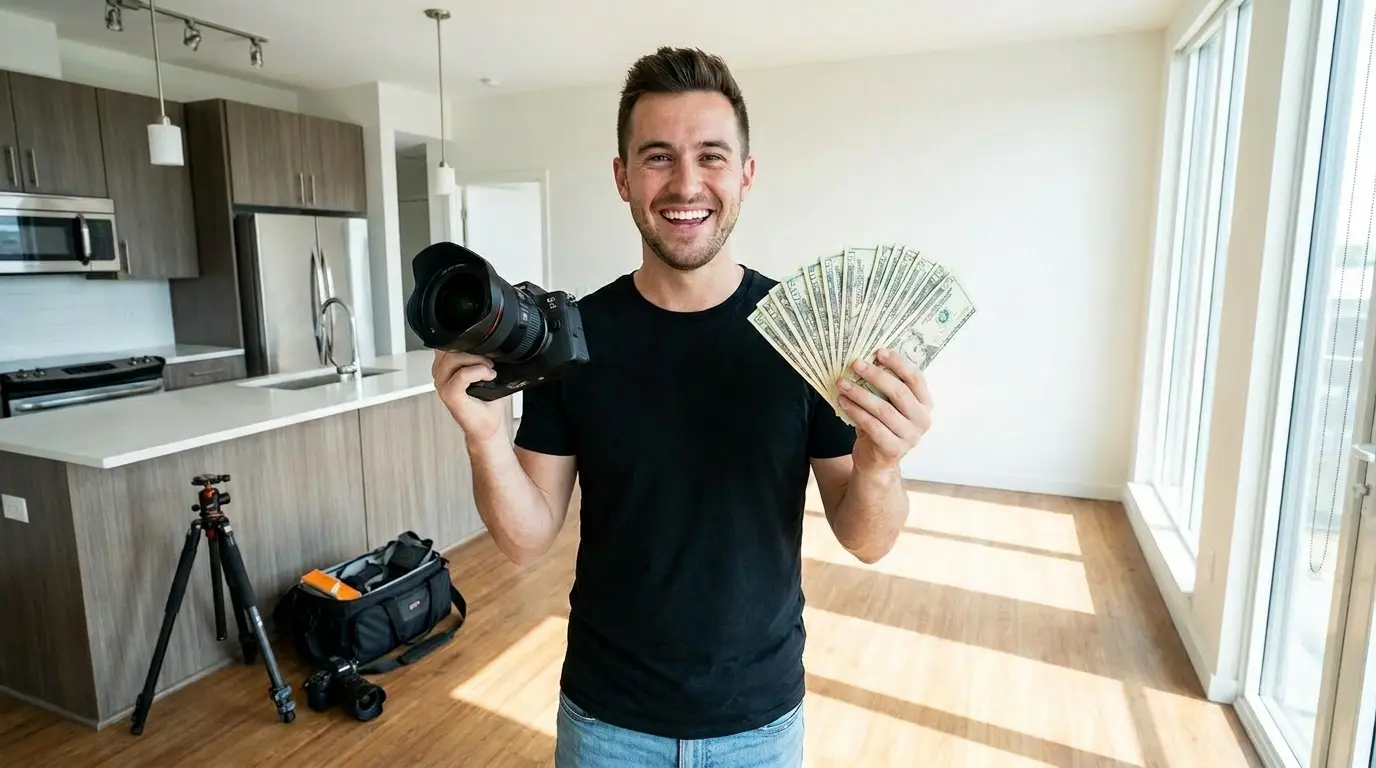
Full-time real estate photographers in the United States typically earn between $50,000 and $90,000 a year, and experienced independents who run their own studio often clear $100,000 to $150,000 or more. The salary-site averages sit lower, roughly $43,000 to $70,000, because they treat the work like a salaried job. It is not. Most real estate photographers are self-employed and paid per listing, so real income comes down to one equation: your price per shoot multiplied by how many shoots you deliver each month.
If you are weighing this as a career or a side business, the honest answer is that the range is enormous, and where you land depends far more on how you price and package your work than on your camera. This guide breaks down the real numbers by employment type and market, shows the per-listing math the salary aggregators hide, and covers the single highest-margin way experienced photographers raise income without shooting more houses. For the wider view of running the business itself, our guide on how to build a profitable real estate photography business goes deeper on operations.
Why the "salary" numbers are misleading
Search this question and you get a wall of salary aggregators, all disagreeing with each other. Indeed reports an average around $42,940. ZipRecruiter lists about $62,338. Salary.com puts the median near $70,085. Three trusted sources, a $27,000 spread, and none of them describe how the job actually pays.
The reason they conflict is that they pull from job postings for salaried W-2 roles, which are a small slice of the market. Most real estate photographers are freelancers paid per listing, not employees earning a fixed wage. A salaried photographer at a large brokerage or a media company might earn a steady $55,000. A self-employed photographer in a busy metro can bill three times that, or half of it, depending on volume and pricing. Averaging those into one "salary" hides the only numbers that matter to you.
The real earnings math: price per listing times volume
Real estate photography income is a volume business built on a per-shoot price. Standard residential packages run from about $150 to $300 for a basic photo set and $250 to $500 for a full listing shoot, with luxury and bundled jobs reaching $500 to $1,500 or more. Our breakdown of real estate photography pricing covers how to set those rates by market.
Once you know your price, annual income is just that price multiplied by how many listings you deliver. Here is what gross revenue looks like at two common price points across realistic monthly volumes.
| Listings per month | At $250 per listing | At $400 per listing |
|---|---|---|
| 10 | $30,000 / year | $48,000 / year |
| 15 | $45,000 / year | $72,000 / year |
| 20 | $60,000 / year | $96,000 / year |
| 30 | $90,000 / year | $144,000 / year |
Two levers move that table: the price you charge and the number of shoots you can realistically fit. Twenty listings a month at $400 is a strong full-time business. Ten listings a month at $250 is a solid side income. The photographers who earn the most are rarely the ones shooting the most houses. They are the ones who raised their price per job, which we come back to below.
What you actually take home after costs
Gross revenue is not income. As a self-employed photographer you carry costs that a salaried employee never sees, and they take a real bite. Plan for camera and lens replacement, a wide-angle body, lighting, a drone if you offer aerials, editing software subscriptions, insurance, vehicle and mileage, and the hours spent editing and driving between shoots. Editing alone can run 20 to 40 minutes per listing if you do it yourself.
Then there is self-employment tax. In the United States, freelancers owe both halves of Social Security and Medicare, roughly 15.3% on net earnings, on top of income tax. A realistic rule of thumb is that a self-employed real estate photographer keeps somewhere between 55% and 70% of gross after equipment, software, driving, editing time, and taxes. So a $90,000 gross year is closer to $55,000 to $63,000 in the bank. That is still a good living, but it reframes the volume math: chasing more low-priced shoots adds cost and windshield time, while raising your price per job drops almost straight to the bottom line.
Earnings by experience and market
Where you sit on the income range tracks closely with experience, market size, and whether you work for someone or for yourself. The rough tiers look like this. Entry-level or part-time photographers building a client base earn about $30,000 to $50,000 a year. Full-time salaried photographers at a brokerage or media company land around $50,000 to $70,000. Established independents with a steady agent roster earn $80,000 to $150,000 or more. Top operators in luxury markets who bundle drone, twilight, video, and floor plans can gross $200,000 or above, though a chunk of that goes back into the business.
Market matters because it sets both your price ceiling and your volume. A photographer in a major metro with high home values and heavy listing turnover can hold higher prices and stay booked. In a smaller market you may need to travel more or add services to reach the same income. If you are still deciding what to charge, our pricing guide and real estate video pricing breakdown give current market ranges for each service.
The fastest way to earn more without shooting more houses
The photographers clearing six figures rarely got there by adding shooting days. They got there by raising average order value: charging more per listing by bundling services onto the same visit. Drone photography adds $100 to $250. Twilight shots add $150 to $300. Floor plans and 3D tours add $100 to $300. The highest-margin add-on of all is video, because you already captured the raw material when you shot the stills.
A real estate photographer who adds a listing video to every shoot can raise average order value by $150 to $300 without adding a single shooting day. That is the difference between a $60,000 year and a $90,000 year at the same volume. The catch has always been production: filming and editing video is a separate skill and a time sink that eats the margin. That is the problem Amplifiles was built for photographers to solve.
Amplifiles turns the listing photos you already delivered into a branded 1080p marketing video in about five minutes, with voice-over and captions, and no filming or editing. It costs $1.50 per image (one dollar and fifty cents per image), so a typical listing video built from a set of photos runs a few dollars in cost against a $150 to $300 upsell. For a photographer, that is close to pure margin added to a job you were already doing. New accounts get 1,200 free credits, which covers roughly eight images, enough to produce your first video before you charge a cent.
Frequently Asked Questions
Can you make good money doing real estate photography?
Yes. A full-time real estate photographer in the United States commonly earns $50,000 to $90,000 a year, and established independents who bundle services and run their own client roster earn $100,000 to $150,000 or more. Income is driven by your price per listing and your monthly volume, not by a fixed salary, so photographers who raise rates and add services out-earn those who simply shoot more houses.
How much do real estate photographers make per hour?
Effective hourly pay varies widely because most of the work is priced per listing, not per hour. A $300 shoot that takes one hour on site plus 40 minutes of editing works out to well over $150 an hour of billable time, though drive time and admin lower the real figure. Salary trackers list roughly $28 to $34 per hour for salaried roles, but self-employed photographers who price well typically clear more.
How much do real estate photographers charge per house?
Standard residential listings run about $150 to $300 for a basic photo package and $250 to $500 for a full shoot, depending on home size and market. Luxury listings and bundled packages that include drone, twilight, floor plans, or video reach $500 to $1,500 or more. Adding services to the same visit is the most common way photographers raise their per-house price.
Do real estate photographers make more by offering video?
Almost always, yes. Adding a listing video raises average order value by roughly $150 to $300 per shoot, and because the video can be built from the photos already captured, it adds little production time. Amplifiles produces a 1080p listing video from existing listing photos in about five minutes at $1.50 per image, which lets a photographer sell video as a high-margin add-on without learning video editing.
How much do Zillow-style listing photographers make?
Photographers who shoot for large listing platforms or brokerage networks are usually paid a flat rate per property, often $50 to $150 per basic shoot, and rely on high volume routed to them by the platform. Independent photographers who own their agent relationships keep the full per-listing price and typically earn more per job, but they carry the cost of finding their own clients.
Final Thoughts
Real estate photography pays a wide range, and the salary-site averages are the least useful way to picture it. Your income is your price per listing times your volume, minus real business costs. The photographers at the top of the range are the ones who raised their price per job by packaging drone, twilight, floor plans, and video onto shoots they were already booking.
We built Amplifiles because video is the highest-margin service a photographer can add and the hardest to produce by hand. Our platform turns listing photos into professional 1080p marketing videos in about five minutes, with voice-overs, captions, and branding, at $1.50 per image. No filming or editing required.
Browse real estate video examples to see what a delivered listing video looks like, or see how Amplifiles works for photographers and start with your 1,200 free credits.