.webp)


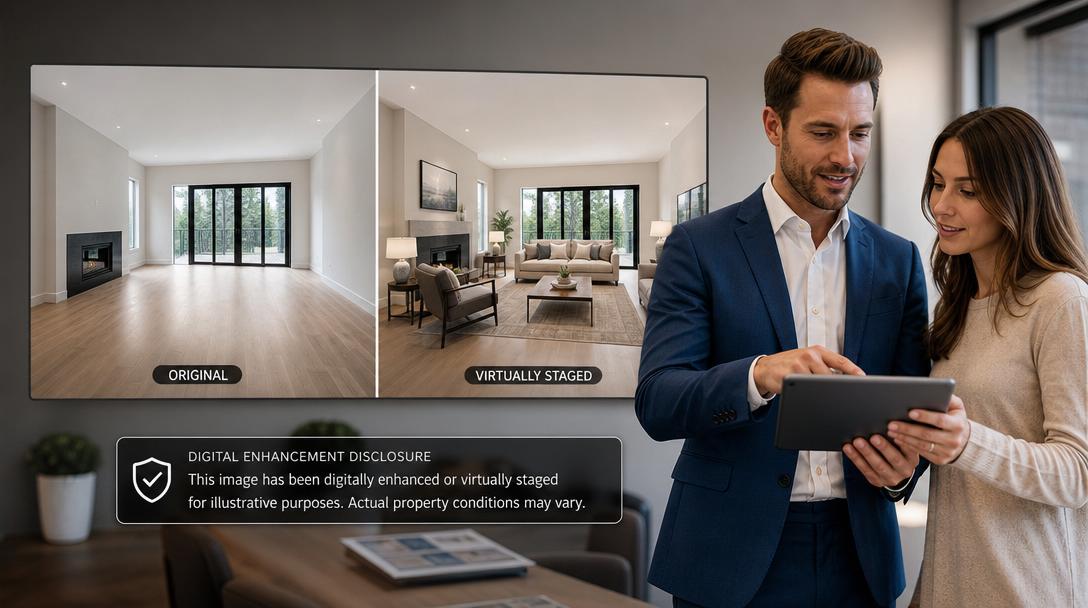
AI virtual staging is legal in every US state. It is also one of the easiest ways for an agent to get a complaint filed, if they skip the disclosure step. California's AB 723, signed in October 2025, made disclosure explicit for AI-altered listing photos as of 1 January 2026. The Texas Real Estate Commission updated its rules the same year. Most states have not passed dedicated AI legislation, but every MLS in the country has rules about altered images that apply to virtual staging by default.
This guide covers what AB 723 actually requires, how other states handle disclosure in 2026, what MLS rules expect even where state law is silent, and the simple five-step disclosure pattern that keeps you compliant in every market. Pair the staged photos with a 1080p listing video from our real estate listing video maker for agents and the marketing motion compounds.
What AI virtual staging actually does to a photo
AI virtual staging takes a photo of an empty or partially furnished room and adds furniture, decor, and styling. The walls, floors, windows, and architectural features of the actual property remain unchanged. The added elements (sofas, beds, art, plants, lighting) are generated by machine learning models and rendered onto the image.
This matters legally because disclosure laws care about one question: is what the buyer sees in the photo what they will find on the property?
A virtually staged photo of an empty living room with a fictional couch and rug is generally allowed. The room is real. The couch is not. As long as the buyer is told the difference, the photo is acceptable advertising.
A photo that changes a physical element of the property itself is not virtual staging. That covers repainting walls, swapping flooring, replacing the sky, or greening a lawn. These edits are generally permitted, but they are alterations rather than staging, and they carry the same disclosure obligation.
A third category is different again. Removing a wall, enlarging a window, editing out water staining, or erasing a cell tower visible from a bedroom window conceals something a buyer would want to know. No disclosure label fixes that. It is deceptive advertising in most jurisdictions regardless of what the caption says. We rule twenty-two specific edits against this line in our guide to real estate photo enhancement rules.
Which edits need a disclosure, and which do not
Virtual staging is the edit that gets discussed, but it is rarely the only one applied to a listing photo. The same shoot usually goes through exposure correction, a sky replacement, and a lawn touch-up before anyone opens a staging tool, and those edits sit in different places on the disclosure line.
The short version: edits that correct the camera need no disclosure. Edits that change the property need one. Edits that hide a defect are not a disclosure question at all.
| Edit | Category | Disclose? |
|---|---|---|
| Exposure, white balance, colour correction | Corrects the camera | No |
| Lens and vertical correction, cropping | Corrects the camera | No |
| Noise reduction, sharpening, upscaling | Corrects the camera | No |
| Removing trash cans, cars, hoses, cords | Changes the property (trivial) | Generally no |
| Sky replacement | Changes the property | Yes |
| Lawn greening, day to dusk conversion | Changes the property | Yes |
| Virtual staging (adding furniture) | Changes the property | Yes |
| Virtual decluttering (removing furniture) | Changes the property | Yes |
| Adding people to a photo | Changes the property | Yes |
| Repainting walls, changing flooring | Changes the property | Yes |
| Removing power lines or a cell tower | Hides a defect | Do not do it |
| Removing water stains, cracks, or mould | Hides a defect | Do not do it |
| Widening a room or moving a wall | Hides a defect | Do not do it |
Two rows surprise people. Sky replacement feels cosmetic because the sky is not part of the house, but it represents conditions that did not exist on the day of the shoot, and AB 723 treats it as a change to a physical element of the image. Day to dusk is the same logic, and it is the single most commonly undisclosed edit in the industry.
The full ruling on all twenty-two edits, including the ones specific to photographers rather than agents, is in our real estate photo enhancement rules guide.
California's AB 723: the first dedicated AI staging law
California enacted Assembly Bill 723 (Pellerin) as Chapter 497, Statutes of 2025. It was signed on 10 October 2025 and became operative on 1 January 2026, adding Section 10140.8 to the Business and Professions Code. It is the first US law that names digitally altered real estate photos, including AI virtual staging, specifically.
The bill requires:
- A reasonably conspicuous statement on or adjacent to any digitally altered image used in advertising or promotional material for the sale of real property, disclosing that the image has been altered.
- A link to a publicly accessible internet website, a URL, or a QR code that includes and clearly identifies the original, unaltered image. Both the statement and the link are required, not one or the other.
- Both elements apply to any image altered through photo editing software or artificial intelligence to add, remove, or change elements of the property. Virtual staging is explicitly covered.
The exact phrasing is not dictated. "Virtually staged" or "Digitally enhanced, furniture not included" both work as the disclosure statement, provided it is reasonably conspicuous and appears on or adjacent to the image. But wording is only half of it: under AB 723 a label alone is not sufficient in California. The original, unaltered image must also be reachable through a link to a publicly accessible website, a URL, or a QR code that clearly identifies it.
California's law applies to:
- MLS listings statewide.
- Listing photos used in digital advertising (Zillow, Realtor.com, social media).
- Print advertising and direct mail.
- Brokerage websites and agent personal pages.
Agents who violate AB 723 face the same penalties as any deceptive-advertising claim under California real estate law: complaints to the Department of Real Estate, possible license action, and exposure to civil claims from buyers who close on the property.
How other states handle disclosure in 2026
Wisconsin is next, on 1 January 2027
Wisconsin Act 69 makes Wisconsin the second state with a dedicated statute covering digitally altered listing images. It becomes operative on 1 January 2027. If you list in Wisconsin, the practical move is to adopt the California pattern now rather than rebuilding your workflow twice.
Those two are the whole list. Every other state currently relies on general deceptive-advertising rules, which are broader in what they cover but far less specific about what a compliant disclosure looks like.
Most states have not passed dedicated AI laws, but every state has deceptive advertising statutes that already cover misleading listing images. Virtual staging falls under those by default.
A few states worth flagging specifically:
Texas. The Texas Real Estate Commission updated advertising rules in 2025 to address "digitally altered visual representations." The requirement: a clear disclaimer on any image that does not reflect current property conditions.
Florida. The Florida Real Estate Commission has long required honesty in advertising. Virtual staging is allowed, but the Florida Realtors Code of Ethics specifically calls out the need to disclose alterations that could mislead buyers.
New York. New York does not have specific AI legislation, but the Department of State's real estate licensing rules require all advertising to be "truthful and not misleading." Staged photos without labels have been cited as grounds for complaints.
Washington. The Northwest MLS adopted a virtual staging policy in 2024 requiring labels on every altered photo and a note in the listing remarks.
Massachusetts. No dedicated state law, but the Greater Boston Real Estate Board's MLS rules require disclosure of any "non-actual" elements in listing photos.
The pattern is consistent: even where state law is silent, MLS rules fill the gap.
What MLS rules require, even without state law
Every MLS in the US has a rulebook covering listing photo standards. Almost all of them now address virtual staging directly. The rules typically require:
- A label on the image itself. "Virtually staged," "Digitally enhanced," or similar.
- A note in the listing remarks. Plain English mention that the property has been virtually staged.
- No alteration of structural elements. Walls, windows, ceilings, and exterior features must match the actual property.
- Original photos available on request. Some MLS boards require agents to keep unaltered originals for compliance review.
Failure to comply usually triggers an MLS warning first, then a fine, then possible suspension of MLS access. That last step is rare but exists.
A few specific MLS systems worth knowing:
- Bright MLS (mid-Atlantic) requires "VIRTUALLY STAGED" in all caps on the image itself.
- CRMLS (California) updated its rules for AB 723 ahead of the law becoming operative on 1 January 2026.
- REBNY (New York City) requires both image labels and listing remarks.
- NTREIS (North Texas) updated rules in 2025 specifically for AI staging tools.
Before you publish a staged listing, check your local MLS handbook. Most updated their rules between 2024 and 2026 and the requirements may have changed since your last training.
The disclosure pattern that works everywhere
The simplest way to stay compliant in every jurisdiction
- Label the image directly. A small text overlay on the staged photo itself. Position it bottom-left or bottom-right, in a color readable against the background. Standard wording: "Virtually staged, furniture not included."
- Add a line to the listing remarks. Something like: "Selected photos have been virtually staged to show furnishing possibilities. Property is unfurnished."
- Publish the originals, and keep your own copies. In California, AB 723 requires the original unaltered image to be reachable from a link to a publicly accessible website, a URL, or a QR code that clearly identifies it as the original. Everywhere else, keep the unaltered photos on file in case of compliance review or buyer dispute.
- Use one design style per listing. Mixing modern staging in the living room with farmhouse in the kitchen confuses buyers about the property's intended audience. Pick one direction.
- Do not stage anything you cannot deliver. AI tools can place a fireplace in a room that does not have one. Do not. Even with disclosure, staging features that do not physically exist invites complaints.
This pattern covers AB 723, every MLS rule we have seen, and the general deceptive-advertising statutes in every state. It is not legal advice (your broker and your MLS have the final word) but it is the operational baseline most agents land on after their first compliance call.
For a deeper breakdown of how virtual staging fits into a full listing marketing workflow, see our real estate virtual staging guide.
What happens when agents skip disclosure
The penalty for skipping disclosure depends on who notices.
The buyer notices. Buyer files a complaint with the listing agent's broker. Most cases resolve at this level with an apology and corrected listing. Buyers occasionally seek to back out of contracts when they discover staged photos misrepresented the property, but virtual staging itself rarely supports that claim if no structural elements were altered.
The MLS notices. Warning letter, then a fine, then in rare cases suspension of MLS access. Fines range from $100 to $1,000 depending on the board.
The state notices. A complaint to the Department of Real Estate (or equivalent body) can trigger an investigation. Penalties range from formal censure to license suspension. Most cases settle with a fine and required ethics training.
The lawyer notices. If a buyer closes on a property believing it was furnished and the listing photos contributed to that misunderstanding, there is exposure to fraud and misrepresentation claims. These are rare but expensive when they happen.
In every case, a one-line disclosure on the photo prevents the entire chain. The cost of staying compliant is near zero. The cost of not is asymmetric.
Frequently asked questions
Is AI virtual staging legal in 2026?
Yes. AI virtual staging is legal in every US state. Most states and MLS systems require the staged photo to carry a clear disclosure label, and California's AB 723 made this explicit for AI-altered images as of 1 January 2026, the date the law became operative.
What does AB 723 actually require?
AB 723 adds Section 10140.8 to the California Business and Professions Code and is operative from 1 January 2026. For any digitally altered image used in advertising or promotional material for the sale of real property, it requires two things: a reasonably conspicuous statement on or adjacent to the image disclosing that the image has been altered, and a link to a publicly accessible internet website, a URL, or a QR code that includes and clearly identifies the original, unaltered image. Virtual staging is explicitly covered, and the law applies across advertising channels with no platform carve-out.
Do I need to disclose virtual staging on social media?
Yes. Most state advertising rules and MLS guidelines apply to social media listings the same way they apply to MLS. If you post a virtually staged photo to Instagram or TikTok with the address attached, label it.
Can I get sued for virtual staging without disclosure?
Yes, though it is rare. The bigger risk is an MLS complaint or a state licensing complaint. Civil suits from buyers happen when the staging misrepresented something material about the property, usually structural changes, not furniture.
What is the difference between virtual staging and image alteration?
Virtual staging adds furniture and decor to a real photo while the walls, floors, windows, and architectural features stay unchanged. Image alteration changes the property itself. That splits in two. Cosmetic alterations such as repainting a wall, replacing flooring, swapping the sky, or converting day to dusk are generally allowed but require the same disclosure as staging. Structural or concealing alterations such as removing a wall, enlarging a window, or editing out water damage are deceptive advertising, and a disclosure label does not make them acceptable.
Where do I put the disclosure label on the photo?
Bottom-left or bottom-right corner, in text large enough to read on a thumbnail. Use a color that contrasts with the image. The exact size and font vary by MLS, but the principle is the same: a buyer scrolling Zillow should be able to tell at a glance that the photo was staged.
This article is general information, not legal advice. Statutes and MLS rules change, so confirm the current requirements with your broker, your MLS, and an attorney licensed in your state before relying on any of it. Last verified: 4 September 2026.
Final Thoughts
Virtual staging is one of the highest-ROI marketing moves available to real estate agents in 2026. Compliance is straightforward once you know the pattern. Label the image, note it in the remarks, keep the originals.
The real opportunity is what you do with the staged photos next. The agents pulling ahead in 2026 are not just staging, they are turning those staged photos into listing videos that get shared on Instagram, TikTok, and Facebook. The same furnished image earns one click on Zillow and a hundred views on Reels.
We built Amplifiles because the gap between "every listing needs video" and "most agents cannot afford a videographer on every listing" was holding back the entire mid-market tier. Our platform turns staged listing photos into professional, watermark-free 1080p marketing videos in about five minutes at $1.50 per image, with an optional AI voice-over that adds captions automatically at no extra cost. No filming or editing required. New users get 1,200 free credits to test it.
Browse our real estate video examples to see what AI listing video output looks like, or read the full real estate virtual staging guide for the deeper playbook on staging plus video as a combined marketing motion.