


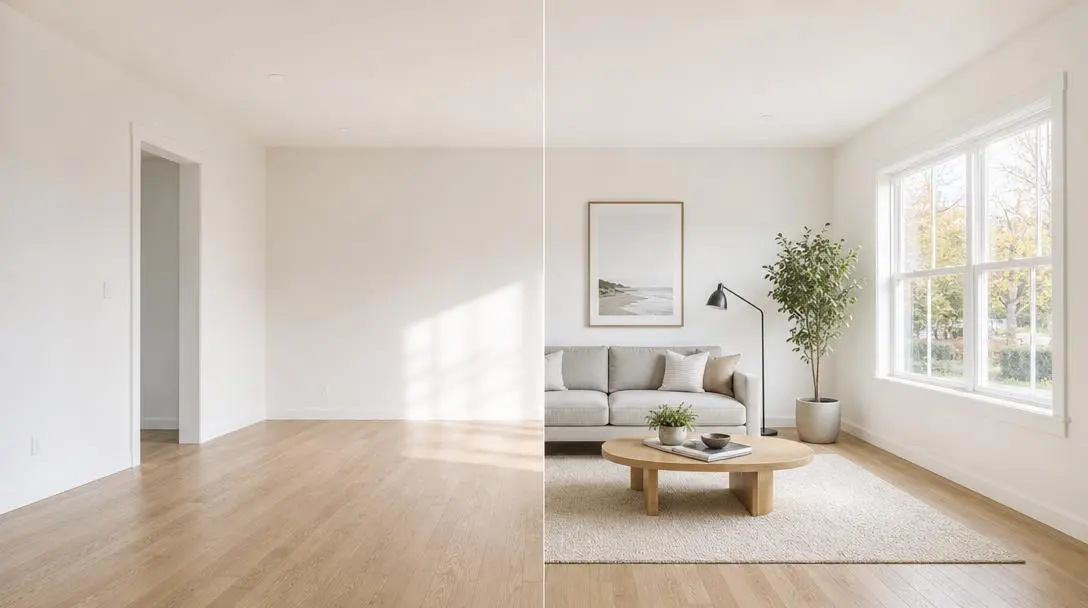
AI in real estate is software that handles the production work around a sale: editing photos, staging rooms, writing descriptions, replying to leads and turning photos into video. Amplifiles is an AI-powered real estate video maker that turns listing photos into branded marketing videos, and it sits in the visual half of this field, the part agents and photographers touch every day. Most guides to AI in real estate cover institutional investors and property valuation models. This one covers what an agent or photographer can actually use this week, what it costs and where it goes wrong. If you want the tool shortlist first, start with our AI tools for real estate agents guide.
What AI does in real estate, by job
Skip the buzzwords and sort AI by the job it replaces. Every use case below replaces a task that costs money or time on a normal listing.
The price ladder matters more than the technology. When a task drops from hundreds of dollars to under a dollar, agents stop skipping it. That is the real change in AI for real estate: not smarter agents, but cheaper production.
How many agents use AI in real estate
The NAR 2026 Technology Report puts daily use at 23% and weekly use at 25%, with 12% of agents saying they have no plans to use AI at all. Among agents who use it, ChatGPT leads at 91%, followed by Gemini at 42%, Copilot at 27% and Claude at 25%. Many agents use more than one assistant, so the figures add up to over 100%. In that report 55% say AI has had a positive impact on their business.
The barriers are mundane. The learning curve (63%) and cost (59%) are the two biggest reasons agents give for holding back. Neither is about trust in the technology. That is good news for visual tools, where there is nothing to learn: you upload a photo and get a result.
If cost is what holds you back, check Amplifiles pricing before you rule it out. The 1,200 free credits cover about 8 images, and no credit card is required.
The big AI reports and what they miss
Most of what ranks for this topic comes from consultancies, banks and trade bodies, and it focuses on commercial property, valuation models and back-office automation. That work is real, but it is not what an agent with six listings or a photographer with a full calendar is buying this month. The practical layer is smaller and cheaper: tools that take a photo in and give a better photo, a staged room or a video out. This guide stays in that layer, because it is where a single person can see a return within a week.
It also helps to separate hype from use. An AI valuation can be a useful second opinion, but it does not replace a comparative market analysis written by someone who has walked the street. A chatbot can answer a lead at 2am, but it cannot read the nervousness in a seller. Every tool in this guide is judged by one question: does it remove a cost or a delay from a normal listing without adding risk?
AI listing visuals: editing, staging and twilight
Visuals are where AI changes the most money per listing, because photos decide whether a buyer clicks. NAR's 2025 Profile of Home Staging found that 81% of agents say staging helps buyers visualize a home. The problem has always been cost. Physical staging runs $2,000 to $5,000 or more, and an empty vacant house is the least clickable listing there is.
Photo editing and enhancement
AI editors adjust exposure, white balance and perspective in bulk, which saves photographers hours. For the line between acceptable correction and misleading change, read our guide to real estate photo enhancement rules and the walkthrough of AI real estate photo editing.
Virtual staging
Virtual staging furnishes an empty room digitally. In Amplifiles you pick one of six styles: Scandinavian, Modern, Mid-Century, Farmhouse, Coastal or Industrial. Walls, floors, ceilings and windows stay as they are, and only the furniture and décor change. Each AI virtual staging edit costs $0.20. Our virtual staging guide covers how to choose a style, and this before and after video walkthrough shows how to turn the empty and staged photos into a reveal clip.
Virtual twilight and time of day
A flat midday exterior is the most common weak photo in a listing. AI can re-light it as sunrise, sunset, twilight or night. Amplifiles offers six Time of Day options and four timelapses such as Day to Night, each for $1.50 per image as part of Quick Animations. The full price comparison is in our virtual twilight photos guide. If you would rather shoot a real dusk exterior, our twilight real estate photography guide covers timing and camera settings.
Declutter, people and elements
Smaller edits matter too. Declutter clears countertops and tables. Add Elements drops in a car in the driveway or a bouquet on a table. Add People places general lifestyle figures into a scene. Describe several changes in one prompt and you pay for one $0.20 edit, not three. Add People and similar additions are the edits most likely to be refused by an MLS, so treat them as social media content.
Disclosure rules you cannot skip
Most MLS systems and a growing number of state rules require you to say when a listing image has been digitally staged or altered. California's AB 723 took effect in January 2026. The rules differ by region, so check yours. Our guide to AI virtual staging disclosure laws tracks the details.
A simple three-bucket test keeps you safe. Corrections that make the photo look like what a person would see, such as exposure and color, rarely need a label. Cleanup that removes temporary items is a judgment call, so label it if in doubt. Anything that adds or changes what is in the home, such as staging, people or a new sky, needs a plain label like "Virtually staged image" or "AI-enhanced visualization".
The workflow that works is two versions. Make a staged or enhanced version for social media and ads, and keep a clean version with the original photos for the MLS. Never use AI to hide a defect or change the structure of a property.
AI listing video from photos
Video is the second place AI changes the economics. Most agents do not have a videographer budget for every listing, and NAR's 2025 Generational Trends report found that only 12% of sellers say their agent used video. Photos still lead: in the staging report, 73% of buyers' agents say photos matter, against 48% for video. That gap is an opening. A listing video made from the photos you already have costs a fraction of a shoot.
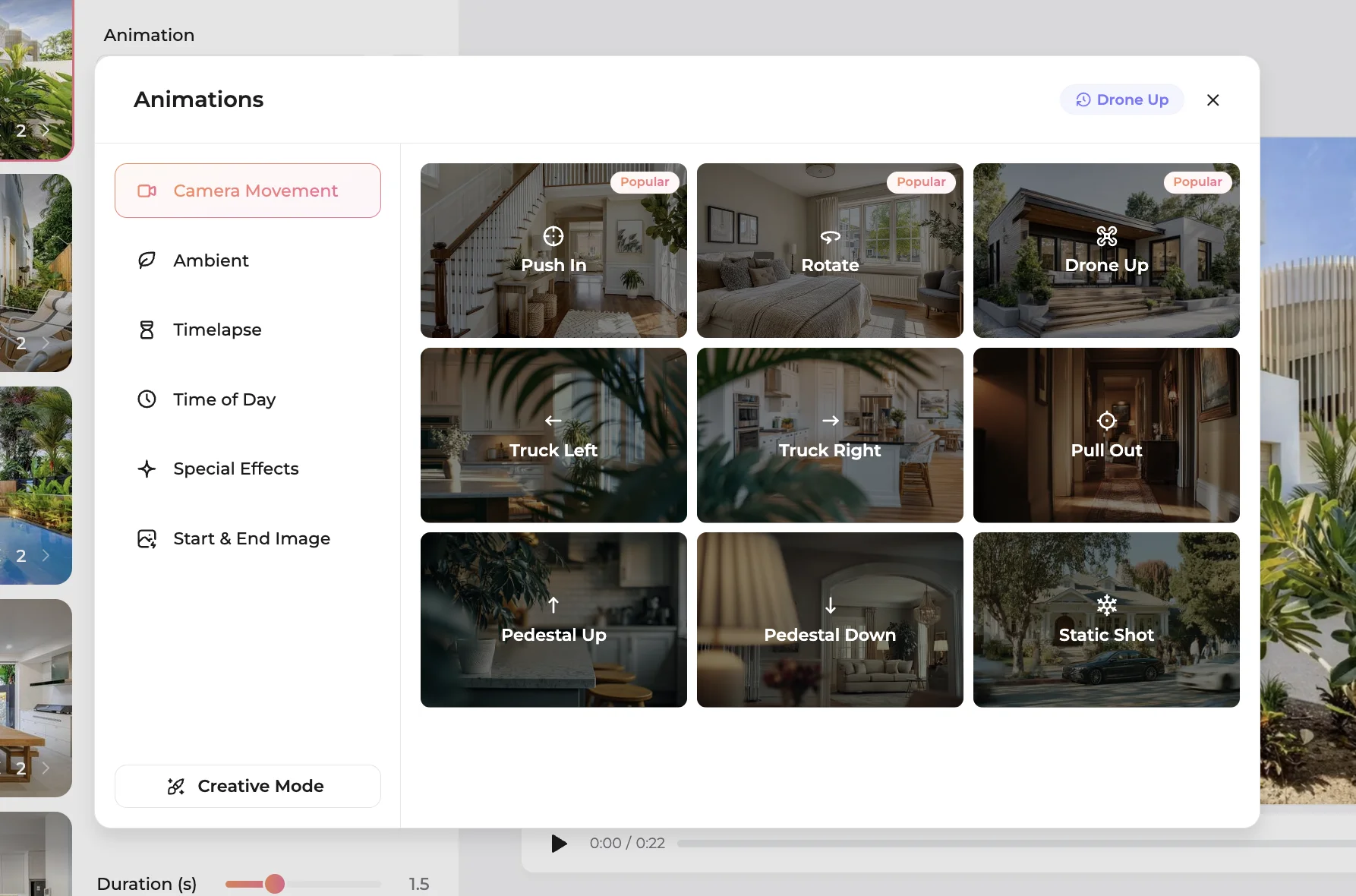
Amplifiles is built for this job. You upload listing photos, pick Quick Animations (camera moves, ambient effects, timelapses and Time of Day) at $1.50 per image (one dollar fifty cents), and the video is ready in about 5 minutes. A typical 8 to 15 photo listing costs $12 to $22.50 pay-as-you-go. New accounts get 1,200 free credits, about 8 images, so you can test it on a real listing.
Here is a finished example, a walkthrough of a modern home made in Amplifiles:
Try it on your next listing: create your first video with 1,200 free credits. No credit card required.
For moments that need more impact, Creative Mode adds virtual staging reveals, Add People scenes, AI Close-Ups, Speed Ramps and Start-End Image transitions at $0.30 per second plus $0.20 for an image edit. Pair that with Beat Sync, where over 30 hand-synced tracks make clips change on the beat, and a slideshow starts to look edited. If you would rather not make the video at all, Done-For-You is a human-edited option at $39, $49 or $59 with delivery in 24 hours and free edits.
For the full picture of tools and costs, see our comparison of AI real estate video tools, and for portal rules see how to add a video to a Zillow listing. If you want the mechanics behind it, read how AI real estate video works.
AI for copy, chat and CRM
Text is where most agents start. ChatGPT reaches 91% of agents who use AI, mostly for listing descriptions, emails and social captions. Models are fast at drafts and slow at facts, so always check square footage, room counts and school names. See our guides on AI listing descriptions and ChatGPT for real estate. Chat and CRM automation help with speed to lead, but a bot that sends the wrong reply to a seller costs more than it saves. Read before it sends.
What AI means for real estate photographers
Photographers see AI as a threat and an upgrade at the same time. Editing and twilight work get cheaper, which squeezes edit-only pricing. But video becomes an add-on you can sell in minutes. Photographers can add video to shoots they have already booked and resell it to clients at their own price, either by making it in Amplifiles or by ordering Done-For-You and keeping the margin. The playbook is in our guide for photographers adding listing video and on the photographers page. If you want the business angle, see the real estate photography hub.
A full listing, priced two ways
Prices are easier to judge on a real listing. Take a vacant 12 photo listing with a flat midday exterior and one empty living room.
With two staging edits the video comes to $18.40 pay-as-you-go ($18.00 for twelve animated images plus $0.40 for two edits). Subscription plans lower the per-image price further. The saving is not the point on its own. The point is that every one of those four tasks now fits inside the budget of an ordinary listing, so none of them has to be skipped.
How to choose an AI tool
The market is crowded and most tools look alike in a demo. Five questions cut through that.
- Does it do one job well, or ten jobs badly? Single-purpose tools are usually better at their one job.
- Does the cost per listing stay predictable? Pay-per-image pricing beats surprise monthly tiers when your volume moves.
- Can you test it free on a real listing? A demo reel proves nothing about your photos.
- Does it keep the original? You need the clean version for MLS and for disclosure.
- Does the output need a rescue? If you spend 30 minutes fixing every result, the tool is not saving you anything.
Once you have picked a video tool, our real estate listing video guide covers where to post the result and how to get it seen.
Where AI still needs a human
There are four places where human judgment still wins. Pricing advice, because a model has no feel for the street. Negotiation, because it is emotional. Fact checking, because models invent room counts and school ratings. And disclosure, because liability stays with the license holder. This is the honest answer to whether AI will replace agents, and our longer take is in will AI replace real estate agents.
A practical rule: let AI do production, and keep people on anything that carries legal weight or trust.
A starter plan for this week
- Pick one listing and run its photos through an AI editor or your usual editor, and keep the clean originals.
- Stage one empty room and note the label you will use.
- Make one listing video and post it on social. Keep a clean version for the MLS.
- Use a chat assistant for the description, then check every number.
You can do steps 2 and 3 in one sitting: stage the room with AI virtual staging, then build the video from the same photos.
Frequently asked questions about AI in real estate
What is AI in real estate?
AI in real estate means software that does work agents, photographers and brokers used to do by hand: editing listing photos, staging empty rooms, writing descriptions, answering leads and turning photos into listing videos. Amplifiles is an AI-powered real estate video maker that turns listing photos into branded marketing videos.
How are real estate agents using AI?
According to the NAR 2026 Technology Report, 23% of agents use AI daily and 25% weekly, while 12% have no plans to use it. ChatGPT is the most used assistant among agents who use AI, at 91%.
Is AI taking over realtors?
No. AI is good at repetitive production work such as photo edits, descriptions and listing videos. Negotiation, pricing advice and local judgment still need a licensed person. Agents who use AI for production simply spend more time on the work clients pay for.
Is AI-edited listing photography legal?
It depends on what the edit changes and where the listing is. Many MLS systems and some state rules require disclosure when listing images are digitally altered, and California's AB 723 took effect in January 2026. Check your local MLS rules, label staged images, and keep the original photos.
How much does AI for real estate cost?
Most AI visual tools cost cents to a few dollars per image. Amplifiles charges $1.50 per image (one dollar fifty cents) for Quick Animations, and virtual staging or another image edit adds $0.20. A typical 8 to 15 photo listing video costs $12 to $22.50 pay-as-you-go.
Can AI make a listing video from photos?
Yes. Amplifiles turns listing photos into a 1080p video in about 5 minutes, with camera moves, time-of-day shifts, ambient effects and beat-synced music. New accounts get 1,200 free credits, enough for about 8 images.
Which AI tools do agents use most?
NAR 2026 data shows general chat assistants lead: ChatGPT 91%, Gemini 42%, Copilot 27% and Claude 25% among agents who use AI. For visuals, agents use dedicated tools for photo editing, virtual staging and listing video.
What should agents never do with AI?
Never use AI to hide defects, change the structure of a property or invent features that are not there. Never publish AI-generated figures or legal claims without checking them, and never skip the disclosure line on altered images.
Final thoughts
AI in real estate is not one thing. It is a set of cheap production tools: photos, staging, twilight, copy and video. The agents who benefit are the ones who pick one job, fix it with a tool that has nothing to learn, and keep the human parts human.
If listing video is your next job, Amplifiles turns the photos you already have into a finished video in about 5 minutes. See how Amplifiles works for real estate agents, or create your first video with 1,200 free credits. No credit card required.