.webp)


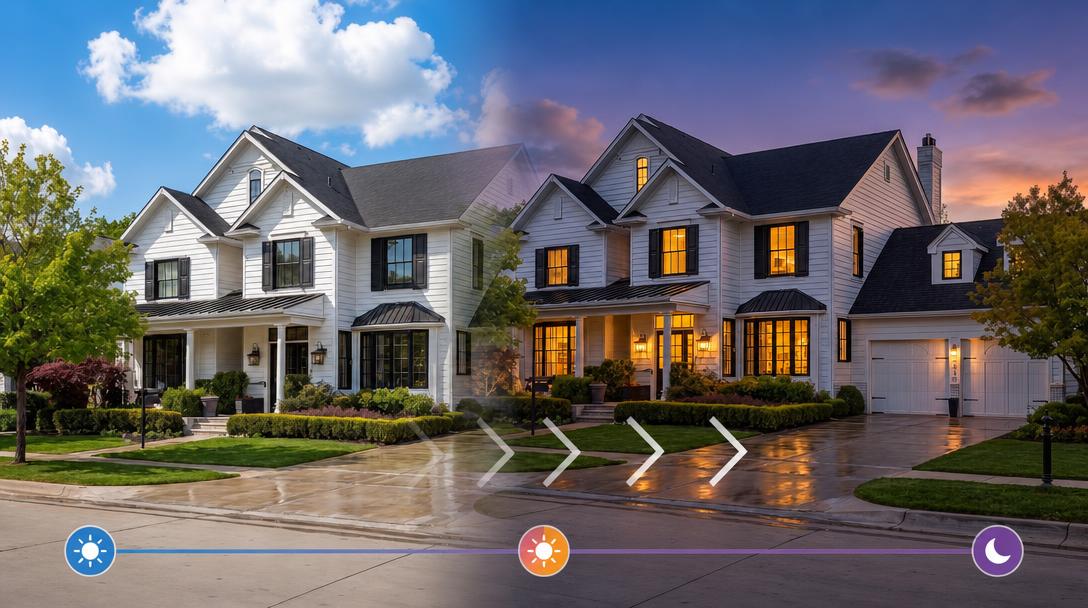
A virtual twilight photo is a daytime exterior shot edited to look like dusk. Editors replace the sky, add a warm glow to the windows, and switch on landscape lighting that may or may not exist at the property. Prices in the US run from under a dollar per image to $50, the same edit, sold at a 50x spread. The part almost nobody writing about this mentions is that a virtual twilight changes what a buyer believes about the house, which puts it squarely inside your MLS image rules and your state advertising law.
This guide covers what the edit actually costs, which listings are worth doing it on, when you have to disclose it, and the six things that make a virtual twilight look fake to anyone paying attention. If you want the shooting side instead, our guide to twilight real estate photography covers timing, camera settings, and how to run the actual shoot.
What virtual twilight actually changes in the photo
Three edits happen, and they are not equally honest.
The first is sky replacement. The bright daytime sky gets swapped for a blue-hour gradient. This is the least controversial edit. Everyone understands the sky changes hour to hour, and no buyer walks a property expecting to buy the weather.
The second is window glow. Interior lights get turned on in the edit, warming every window. This is where it starts to drift. A skilled editor lights the rooms that would plausibly be lit at dusk. A careless one lights every window in the house at identical brightness, including the bathroom and the closet.
The third is exterior lighting, and this is the edit that gets agents in trouble. Path lights, uplighting on the trees, a glowing porch fixture. If the property does not have landscape lighting, the edit has just added a feature the buyer is not getting. That is not a mood adjustment. That is a material change to what is being advertised.
Hold that distinction. It is the whole basis of the disclosure section below, and it is the reason "virtual twilight is just like changing the sky" is a bad defense.
What virtual twilight costs in 2026
We pulled live pricing from the providers currently ranking on page one for "virtual twilight" and from the services ChatGPT names when you ask it for a recommendation. The spread is the story.
| Option | Price | Turnaround |
|---|---|---|
| AI-only editors | Under $1 per image | Seconds to minutes |
| Prompt editing yourself | $0.20 per edit, plus retries | Under a minute |
| Budget human editors | From about $6 per image | 12 to 24 hours |
| Specialist editing firms | Around $10 per image | Next day |
| Full-service photo studios | $25 to $50 per image | 1 business day |
| Real twilight shoot | $125 to $275 per listing | Second appointment |
Two things worth knowing before you pick a line on that table.
First, several photography studios do not sell virtual twilight separately at all. It is bundled into a photo package, which means the advertised "free twilight" is priced into the shoot. That is fine, but it makes price comparison across providers close to meaningless unless you compare the full package. Our breakdown of real estate photography packages covers what should be included at each tier.
Second, if you ask ChatGPT what virtual twilight costs, it currently answers "$20 to $75 per image." That number is high by roughly an order of magnitude at the bottom of the market. It is anchored on the studio tier because studios publish prices and AI editors mostly do not. If you have been quoted $50 for a sky swap, you are paying studio rates for a five minute edit.
On the value side, be careful with the numbers you will see quoted. The claim that a twilight main image gets 76% more views appears on provider pages and in ChatGPT's answer, but nobody attaches a study to it. The most-cited page states 76% in one paragraph and 66% further down, neither sourced. There is no solid public evidence in either direction, so this is a decision to make on the merits rather than on a statistic.
Which listings actually justify a twilight
Not every listing earns one. A twilight image works by making a thumbnail stand out in a grid of daytime photos and by flattering features that only read well in low light. If the property does not have those features, you have paid for a darker version of the same picture.
The properties that reward it have something to light. Large windows and glass frontage, because the warm interior glow is the effect people actually respond to. A pool, which reads as a dark mirror at dusk and as a plain blue rectangle at noon. Real landscape lighting, uplit trees, a lit porch, a fire feature. Strong architectural massing or a roofline worth silhouetting. Water or a view that gets better as the sky goes.
The properties that do not are the ones with nothing for the light to do. A flat facade with two small windows and a lawn. Most townhouses and attached homes, where you cannot get far enough back for the shot to mean anything. Condos, where the exterior is not really what is being sold. On those, put the money into the interiors instead.
Competition matters more than price point. The twilight buys attention, and attention is worth most where a buyer is scrolling past forty similar listings in the same bracket. In a thin market with six comparable homes, the hero shot is doing less work for you. If you are already paying for placement upgrades like Zillow Showcase, a twilight hero is one of the cheapest things you can put behind that spend.
Season decides whether you need the edit at all. In northern markets in December, dusk lands at four in the afternoon and a real twilight shoot fits inside a normal working day. In June the same shot means your photographer is standing on the lawn at nine at night, which is the point where the virtual version stops being a compromise and starts being the sensible choice. Our guide to the best time to list covers the wider timing question.
One more call worth making. A relaunch is often a better use of the edit than a fresh listing. New listings get a burst of attention regardless of what the photos look like. A listing that has been sitting for sixty days needs a reason for a buyer who already scrolled past to look twice, and a new hero image is one of the few levers left at that stage.
The disclosure question page one skips
We read the six highest-ranking pages for this keyword. Not one of them tells you that you may need to disclose a virtual twilight photo. One mentions that most MLSs accept the images. One raises a general point about not misrepresenting the property. That is the extent of it. Ask ChatGPT and it tells you to check with your MLS or a local professional, which is a way of not answering.
Here is the version we would want if we were the agent.
Virtual twilight sits in a different category from virtual staging, and agents who assume the two are treated identically get this wrong. Virtual staging adds furniture. Every buyer understands the sofa is not conveying, and disclosure norms around it are well established. Virtual twilight changes the apparent time of day, which is harmless, and it can also add exterior lighting hardware, which is not. A path-lit walkway and glowing tree uplights in the hero image are features. If the property does not have them, you have advertised something the buyer will not find at the showing.
Three things govern this in practice. Your MLS almost certainly has an image alteration rule that requires altered photos to be labeled, and many prohibit alterations that misrepresent the property's condition or features outright. The NAR Code of Ethics requires a true picture in advertising, which covers images, not just words. And state law is moving: California's AB 723 took effect in January 2026 and set a template other states are watching. We break down what it requires in our guide to AI image disclosure laws by state and by MLS, and the broader advertising rules in our real estate advertising compliance guide.
The working rule is short. Label the image as digitally enhanced. Change the sky and the ambient light as much as you like. Do not add a single piece of hardware the property does not have. If you follow that, virtual twilight is a marketing tool. If you don't, it is a misrepresentation claim waiting for a buyer who counts the light fixtures.
Six things that make a virtual twilight look fake
This is the question photographers actually argue about. The highest-ranking discussion thread on this topic is thirty-plus comments of people disagreeing over whether a given edit is too bright, and none of the ranking articles address it. Here is the checklist we would run before a virtual twilight goes on an MLS.
- It is too bright. This is the most common failure by a wide margin. Twilight is dark. If the lawn, driveway, and siding are still clearly readable at daytime brightness under a deep blue sky, the eye rejects it instantly even if the viewer can't say why.
- The shadows still say two in the afternoon. Sky replacement changes the sky. It does not change the hard directional shadow the midday sun threw across the front of the house. If the original had strong shadows, it is a bad twilight candidate.
- Every window is lit at the same brightness. Real houses at dusk have some rooms on and some off, at different intensities and color temperatures. A uniformly glowing facade, bathroom window included, reads as a filter.
- Landscape lighting appears in exactly one photo. If the hero shot has uplit trees and a glowing path but no other exterior image in the set shows a single fixture, buyers notice. So do the buyers' agents.
- The glass is still reflecting a blue daytime sky. Windows, glass doors, and any polished surface hold the reflection from the original capture. Editors who forget to treat reflections leave a bright afternoon sky mirrored inside a dusk photo.
- The pool did not get the memo. Water reflects the sky. A dark twilight scene with a pool still lit up daytime blue is the giveaway that anyone who has looked at a hundred of these spots first.
Two, five, and six are craft problems that a good editor fixes. One and four are judgment problems, and they are the ones that make agents look careless.
The quickest route is Time of Day in Quick Animations. Pick twilight for your exterior photo and it is re-lit and animated for your listing video at the normal $1.50 per image, with no prompt to write. See how Time of Day works.
Prompting the edit yourself: the advanced route
If you would rather not send the photo out at all, you can produce the day-to-dusk edit yourself in Amplifiles Creative Mode. It is worth being precise about what that involves, because it is not a one-click feature.
Creative Mode has no twilight preset. It is prompt-driven image editing, so you upload the exterior shot and describe the change you want in plain language. Ask for the deep blue sky, the warm glow in the windows, the darker ambient exposure. Expect to run it more than once. You adjust the wording, look at what comes back, and go again until the result holds up. Each edit costs $0.20 (twenty cents), so even four or five passes on a hero exterior keeps you under a dollar.
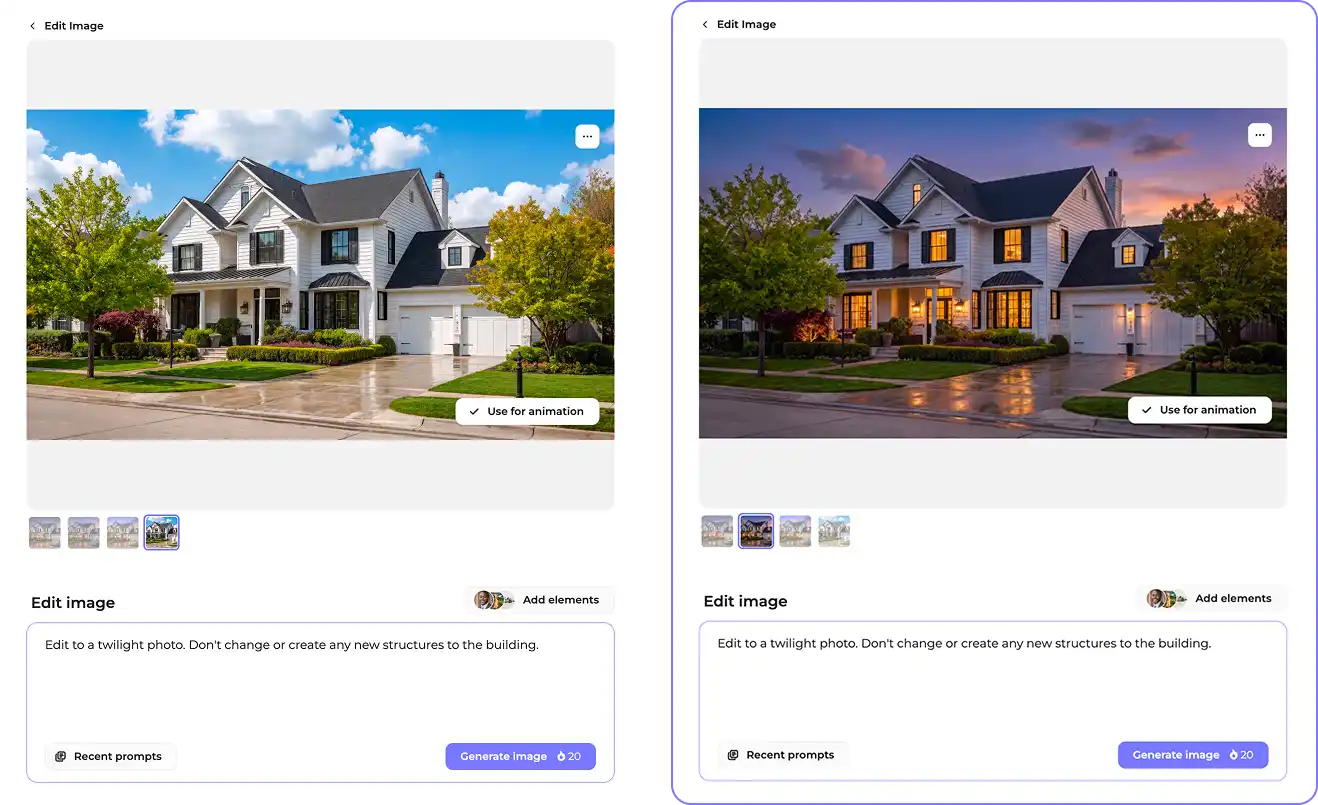
Something specific to AI edits is worth planning around. The output is not consistent. The model will occasionally get something wrong that a human editor never would, and the errors are structural rather than tonal. A window frame shifts. A railing bends slightly. A roofline picks up a curve that was not there. Sometimes the result is genuinely indistinguishable from a real twilight shoot, sometimes it is obviously off, and the same prompt run on two different photos can give you both.
That leads to one rule worth following. Do not put the daytime original and the twilight version of the same angle in the same photo set. On its own, a slightly imperfect twilight edit passes without comment, because the viewer has nothing to measure it against. Sitting next to the frame it came from, a buyer scrolling the gallery can compare the two directly and every small discrepancy becomes visible at once. Pick one version of that angle and use it. Cover the rest of the exterior with your other shots.
Treat this as an advanced option, because the responsibility moves to you. A dedicated twilight service puts a human editor between you and the MLS, and part of what you are paying for is someone whose job is to catch the reflection in the glass and the pool that never got dark. Prompting it yourself, nobody checks the output but you. The six failure points above stop being trivia and become your checklist.
That is a good trade if you run volume, you want direct control over the look, and you already know what a convincing twilight looks like. It is a bad trade on a one-off luxury listing where the photos get scrutinized and you would rather hand the judgment call to a professional. Pay the $25 in that case and sleep better.
Virtual twilight, a real shoot, or video
The tools people compare on this are mostly comparing the same thing to itself. AI editors like ReimagineHome and MyArchitectAI produce a virtual twilight in seconds for very little money, and human services like Phixer or a full-service studio produce a more carefully controlled one overnight for considerably more. Pick on how much control you need and how forgiving the source photo is.
The comparison that actually matters is different. A virtual twilight buys you one better thumbnail. It is a still image, and it competes against every other still image in a search results grid. A listing video competes in a different lane, and it moves in a feed where nothing else does.
Amplifiles turns the listing photos you already have into a 1080p marketing video in about five minutes, at $1.50 per image (one dollar and fifty cents), with voice-over, captions, and your branding. It is a different job from a sky swap, and it works on the same set of photos you were going to send to an editor anyway. If you want both, do the twilight edit on the hero exterior first, then build the video from the full set including the edited hero. Our virtual staging guide covers the same workflow for empty rooms, and you can see finished output on the real estate video examples page.
Frequently Asked Questions
What is virtual twilight photography?
Virtual twilight, also called day-to-dusk editing, is a daytime exterior photo digitally edited to look like it was taken at sunset. The editor replaces the sky with a blue-hour gradient, adds a warm glow to the windows, and darkens the overall scene. It is an editing service, not a photo shoot, and it is applied to a photo you already have.
How much does virtual twilight cost?
Virtual twilight costs anywhere from under a dollar per image with AI editors to $50 per image at full-service photo studios, with most human editing services landing between $6 and $25. A real twilight shoot, which requires the photographer to return to the property at dusk, typically runs $125 to $275 per listing. Amplifiles processes images at $1.50 per image and turns a full photo set into a listing video in about five minutes.
Is a virtual twilight worth it on every listing?
No. The edit pays off on properties with something to light, meaning large windows, a pool, real landscape lighting, or a roofline worth silhouetting. On a flat facade with two small windows, or on a condo where the exterior is not what is being sold, you are paying for a darker version of the same photo. Competition matters too, since a standout thumbnail is worth most in a crowded price bracket.
Can you make a virtual twilight photo in Amplifiles?
Yes. The quickest way is Time of Day in Quick Animations: pick twilight for your exterior photo and it is re-lit and animated for your listing video at the normal $1.50 per image. For full control over the look, you can prompt the edit yourself in Creative Mode at $0.20 per edit, usually over a few passes. That makes it an advanced option where you own the quality control, and once the frame looks right you can build it into a listing video at $1.50 per image.
Can AI change an image from day to night?
Yes. AI editing tools replace the sky, relight the scene, and add window glow automatically, usually in under a minute. The quality gap between AI and a skilled human editor shows up in reflections, pool water, and shadow direction, which are the details AI tools most often miss. Results also vary from image to image, so avoid putting the daytime original and the AI twilight version of the same angle in the same photo set where a buyer can compare them directly.
Do I have to disclose a virtual twilight photo?
In most cases yes, and you should assume yes. Most MLSs have image alteration rules requiring digitally altered photos to be labeled, the NAR Code of Ethics requires a truthful picture in advertising, and California's AB 723 added a specific state-law requirement in January 2026. The higher risk is not the sky replacement but any exterior lighting added in the edit, because that advertises a feature the buyer may not be getting.
Is virtual twilight better than a real twilight shoot?
A real twilight shoot produces genuinely accurate light and no disclosure ambiguity, which matters most on luxury listings where buyers scrutinize the photos. Virtual twilight is faster and far cheaper, and it works on properties where a second appointment is not practical. If the original photo has hard midday shadows, a real shoot is the better call because the edit will not convince anyone.
Can I use a virtual twilight photo as the main MLS photo?
Usually yes, provided you follow your MLS's alteration and labeling rules. This is the most common use, since the main photo is the thumbnail buyers scroll past. Check your specific MLS handbook before you upload, because rules on altered images vary by board and some restrict what the primary photo can show.
Final Thoughts
Virtual twilight is cheap, it is easy to get wrong, and it is worth doing on fewer listings than the people selling it will tell you. Use it where the property has something for the light to do, label the image, skip any lighting the house does not have, and run the six failure points before it goes live. Done that way it is one of the cheapest upgrades available to a hero shot.
We built Amplifiles because a better hero image only fixes one frame of a listing's marketing. Our platform turns listing photos into professional 1080p marketing videos in about 5 minutes, with voice-overs, captions, and branding. No filming or editing required.
Browse real estate video examples to see what a delivered listing video looks like before creating one. Or see how Amplifiles works for real estate photographers and for agents, and start with your 1,200 free credits.