


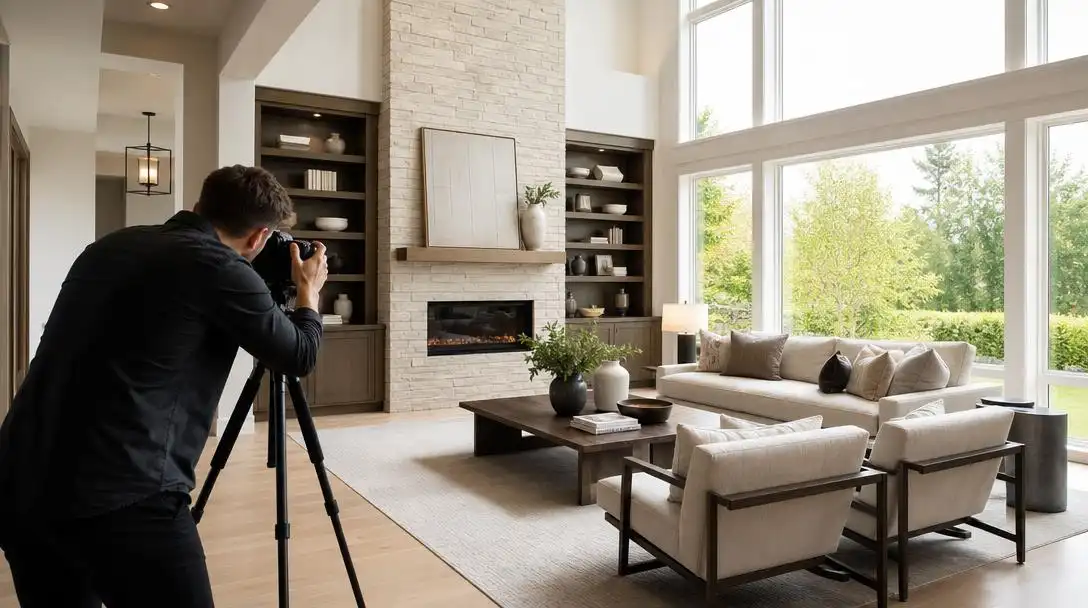
Real estate photographers in most US markets charge between $150 and $350 per shoot, and a booked photographer can cover two or three homes in a single day. That is a real income from a skill you can learn in a few months. Yet most guides on getting started skip the parts that actually decide whether you make it: how long the ramp really takes, what your first clients cost you, and how to stand out once every agent in your area already has a photographer.
This guide walks the whole path, from your first practice shoot to a booked calendar, with real numbers at each step. If you want to sharpen the craft side as you go, keep our real estate photography tips open in a second tab. This piece is about the business path around it, and our real estate photography guide covers the wider picture of what the work pays and what AI changed.
What a real estate photographer actually does
A real estate photographer shoots the interior and exterior of a property so it sells faster and shows well online. The job is less about artistic vision and more about consistency. An agent needs every room captured cleanly, verticals straight, windows exposed so you can see the view, and the full set delivered by the next morning. Reliability and turnaround win repeat work more often than any single stunning frame.
The demand is steady because listings turn over constantly and agents rarely shoot their own photos well. The work also expands naturally into higher-paid deliverables: twilight exteriors, drone shots, floor plans, and listing video. Those add-ons are where the money moves from a side income to a full-time one, which is why the last third of this guide matters as much as the gear.
The gear you need to start (and what you can skip)
You do not need the most expensive setup to take your first paid job. You need equipment suited to interiors and architecture, which means a camera that brackets exposures and a lens wide enough to make rooms feel their real size.
A workable starter kit is a full-frame or crop-sensor camera that supports exposure bracketing, a wide-angle lens (roughly 16 to 35mm on full frame, or 10 to 24mm on crop), a sturdy tripod with a level, and a single flash. Skip the second body, the drone, and the 360 camera until clients are paying for those specific deliverables. Buy the tripod new and the camera used, because a solid tripod matters more to your final image than another megapixel. Our real estate photography equipment guide and best lens breakdown cover the specific bodies and glass worth buying.
Budget expectation: a competent used kit runs $800 to $1,500. You can start lower with a camera you already own, but a real wide-angle lens and a stable tripod are the two purchases you should not cut.
Learn the four skills that decide your photos
Before you charge, get consistent at four things. Everything else is refinement.
Straight lines. Keep vertical walls and door frames vertical and horizontal lines level. Crooked verticals are the fastest way to look like an amateur, and they are the hardest thing to fully fix later. A tripod with a built-in level solves most of it.
Exposure and HDR. Interiors and windows have wildly different brightness. Learn to bracket several exposures and blend them so the room is well lit and the window still shows the yard. Our HDR real estate photography guide walks through the blend step by step.
Flash. A single off-camera flash bounced off the ceiling cleans up color casts and fills shadows that bracketing alone cannot. It is optional on day one and essential by month two.
Editing. Learn Lightroom well enough to correct perspective, balance color, and brighten rooms without the overcooked look that screams filter. A curated, natural edit beats a heavy one every time.
The most reliable way to build these is to shoot the same rooms repeatedly and compare. Learning to photograph an average home consistently is worth far more than capturing one great image once.
Build a portfolio before you charge
New photographers hit a chicken-and-egg wall: agents want to see real estate work, and you have none. Break it by creating your own. Shoot your home, then friends and family homes, then offer a few free or heavily discounted shoots to attractive listings. You can also find dated listings on Zillow and reshoot them on your own to build a set.
Aim for 10 to 20 excellent images, not hundreds of average ones. Agents scan a portfolio in seconds and judge you by your weakest visible shot, so cut anything you are not proud of. Put the set on a simple, fast website and an Instagram account. Our portfolio guide covers how to structure and present it.
How to land your first five clients
The fastest path to paying work is direct, personalized outreach, not waiting to be found. Target local agents whose current listings have weak photos, newer agents building their business, small brokerages, home stagers, builders, and short-term rental hosts.
Keep the first message short and specific: say you are a local real estate photographer, that you noticed their listing, and that you would like to shoot their next one with fast turnaround and a satisfaction guarantee. Avoid mass generic blasts. A handful of tailored notes each day beats a hundred copies of the same email. Lower the risk for a first-time client with a discounted first shoot, a free twilight edit, or same-day delivery, then raise your prices once you have reviews and repeat bookings.
After every delivered gallery, ask the happy client to refer a colleague. One satisfied agent can introduce you to several more, and referrals become the backbone of a full calendar. For a deeper system, see our guide on getting real estate photography clients.
What you can charge and what you can earn
Pricing varies by market and by what you deliver, but the working ranges are consistent enough to plan around.
Your first shoots should be discounted to build the portfolio. After 10 to 20 successful jobs you can charge market rates, and as demand grows you raise prices rather than trying to cram in more shoots. Photographers who earn the most do it through efficiency, add-on deliverables, and repeat clients, not by being the cheapest option in town. For a full breakdown of income by market and experience, read how much real estate photographers make and our pricing guide.
The 2026 edge: sell listing video, not just photos
Here is the part the generic guides miss. In most markets, every agent already has a photographer they are happy with. Competing on photos alone means competing on price, which is a slow way to grow. The photographers pulling ahead right now add a deliverable the agent cannot easily get elsewhere: a listing video.
You do not need a gimbal, a second shooting day, or an editing suite to offer it. You already captured the photos. You can turn that same set into a branded video. There are three realistic ways to add video to a package, and they are not equal.
Amplifiles is an AI real estate video maker that turns your listing photos into a branded 1080p video in about five minutes, with voice-over, captions, and your logo. It costs $1.50 per image (one dollar and fifty cents), and new accounts get 1,200 free credits, which is enough for roughly eight images at no cost. For a new photographer, that means you can offer a video add-on for a small flat fee, deliver it the same day you deliver photos, and charge the agent more for the whole package without buying a single piece of video gear. See real estate video examples to judge the output before you offer it, and the photographer workflow for how it fits a shoot. If you would rather not build the videos yourself, Done-For-You has our human editors make them from your photos within 24 hours, from $39 per listing, and you resell them to your agents at your own price. To film your own instead, our real estate videography guide compares the DIY route.
A realistic 90-day ramp
You will not book a full calendar in week one, and any guide that promises it is selling something. A workable pace looks like this. In your first two weeks, learn the four skills and shoot three or four practice homes. In weeks three and four, build the portfolio site, set up Instagram and a Google Business Profile, and start reaching out to 10 to 20 agents a day. Through month two, complete your first discounted shoots, collect reviews, and add flash and a video add-on to your package. By month three, raise rates to market, lean on referrals, and keep outreach going while your recent work does some of the selling for you.
The hardest part is almost always landing that first client, not the gear or the editing. Consistent outreach with a clean portfolio and a genuine offer beats perfect equipment every time.
Frequently Asked Questions
Do you need a license to become a real estate photographer?
No. In the United States there is no license or certification required to photograph real estate, and agents hire on portfolio quality, turnaround speed, and reliability rather than credentials. The one exception is drone work: flying a drone commercially requires an FAA Part 107 certificate, so you only need that if you add aerial shots to your services.
How hard is it to become a real estate photographer?
The craft is learnable in a few months of deliberate practice. The technical skills, straight verticals, exposure blending, flash, and editing, are teachable and repeatable. The harder part is the business side: landing your first clients and building a referral base. Most people who quit do so because they stop reaching out, not because they cannot take a good photo.
How much do agents pay a real estate photographer?
Most US shoots fall between $150 and $350, depending on the market, the size of the home, and the deliverables. Add-ons raise the total: twilight exteriors, drone shots, floor plans, and listing video each command extra. Photographers who bundle video and twilight into a premium package earn meaningfully more per booking than those selling stills alone.
Can I offer listing video without video gear or editing skills?
Yes. You can turn the listing photos you already shot into a finished video with Amplifiles, which produces a branded 1080p listing video in about five minutes at $1.50 per image. That lets a photographer add video to a package the same day, with no filming, no gimbal, and no editing, and charge the agent more for the complete deliverable.
How do you become a real estate photographer with no experience?
Start by shooting homes you have access to, your own and those of friends and family, until you can capture an average house cleanly and consistently. Build a tight portfolio of 10 to 20 images, put it on a simple site, then offer discounted first shoots to local agents to convert practice into paid, reviewed work. Experience compounds quickly once the first few clients are on your books.
Final Thoughts
Becoming a real estate photographer is less about buying the perfect camera and more about getting consistent, showing up reliably, and giving agents a reason to pick you over the photographer they already use. In 2026, the clearest reason is a deliverable they cannot easily get elsewhere, and listing video is the obvious one.
We built Amplifiles so photographers can add that video without a second shooting day or an editing suite. Our platform turns listing photos into professional 1080p marketing videos in about five minutes, with voice-overs, captions, and branding, at $1.50 per image. No filming or editing required.
Browse real estate video examples to see what a delivered listing video looks like, then explore how Amplifiles works for photographers and start with your 1,200 free credits.