.webp)


Amplifiles and AutoReel are both AI real estate video tools that convert listing photos into social-ready videos in minutes, and their per-video costs land in a similar range. The real difference is how you pay and how much control you get. Amplifiles is pay-as-you-go at $1.50 per animated image (about $15 for a typical video) with 1,200 free credits, no subscription, no cap on photos per video, 4K output, and a full Creative Mode. AutoReel has a permanent free plan at 720p with a watermark, and paid tiers from $30/mo billed annually ($59 month to month) for three videos a month at 1080p, with a Studio timeline editor, AI voiceovers and avatars. Agents who want no monthly commitment, uncapped photos and 4K fit Amplifiles; agents who publish a steady volume and want a timeline editor fit AutoReel.
Both tools clear the same bar: upload photos, get a captioned, music-backed video without editing skills. Where they diverge is the commitment, the caps, and the creative ceiling. Here is the full comparison, with AutoReel's figures checked against their own documentation in August 2026.
Amplifiles vs AutoReel at a glance
AutoReel figures checked against autoreelapp.com, their help centre and their public API on 24 August 2026. AutoReel describes its current annual discount as promotional, so verify before relying on it.
Pricing: usage-based vs subscription
The per-video math is closer than you might expect. The difference is the commitment.
Amplifiles is pay-as-you-go. You pay $1.50 per animated image, so a standard 8 to 15 photo video lands at $12 to $22.50, and you only pay when you create. The 1,200 free credits new accounts receive carry no watermark and unlock every feature, with no card required. There is no monthly bill and no video cap. Optional subscriptions from $29/mo lower the per-image rate for heavy users, but none is required.
AutoReel has a permanent free plan and paid tiers. The free plan gives two videos a month with no credit card, capped at 720p with a watermark and 15 seconds. Paid plans start at $30/mo billed annually ($59 month to month) for three videos a month, which works out to $14 to $20 per video. Growth is $90/mo annually ($139 monthly) for ten videos a month, and Pro is $165/mo annually ($249 monthly) for twenty. A 7-day trial gives three watermark-free videos.
No commitment, no cap. Amplifiles bills only when you make a video and never limits how many photos go into one. AutoReel caps videos per month and photos per video on every tier.
So the honest read: AutoReel's per-video cost is competitive, especially on annual Growth or Pro, and its free plan is genuinely permanent rather than a countdown. But paid plans bill every month whether you list or not, and both the number of videos and the photos per video are capped. Amplifiles charges only when you create and lets you build as long a video as the listing needs.
Where Amplifiles wins
Nine camera moves against five. AutoReel's camera motion is a closed set of five: push in, push out, orbit left, orbit right, or auto. That is confirmed in its help centre and in its public API, where the camera motion field accepts only those values. Amplifiles' Camera Movement category holds nine one-click options, including Truck Left and Right, Pedestal Up and Down, Rotate, Drone Up and Pull Out, plus a Static Shot when you want no movement at all.
More than 30 one-click effects, and none of them rationed. Camera Movement is one of six Quick Animations categories. The others are Ambient (fireplace, water, ceiling fans, TV screens, declutter), Timelapse, Time of Day lighting shifts, Special Effects and Start and End Image animations. Every one of them costs the same flat $1.50 per image, and nothing limits how many you use in a video. AutoReel publishes 13 named VFX effects and meters them: three per video on Essential, six on Growth, eight on Pro.
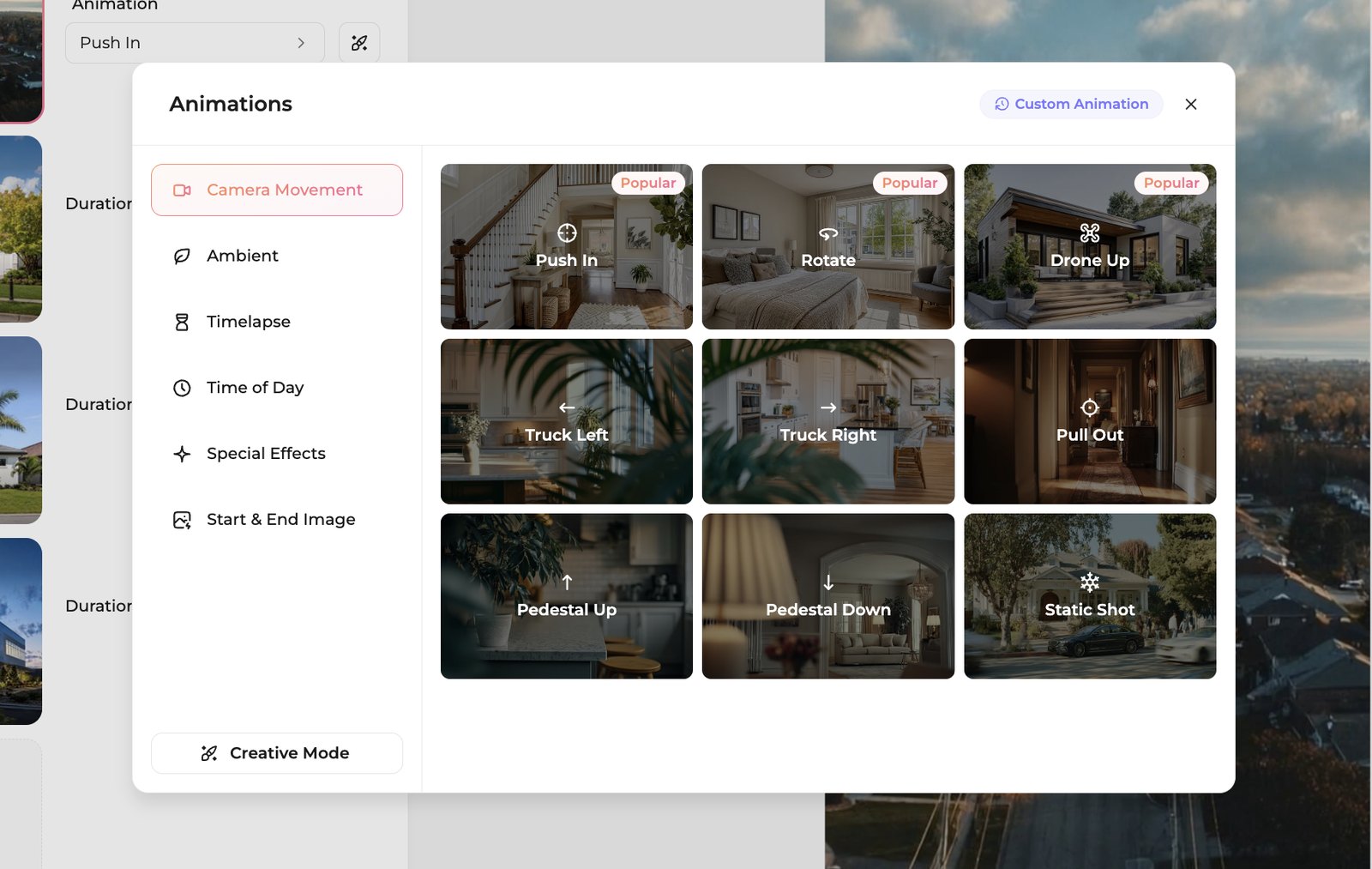
Start and end frames, not just a starting photo. Amplifiles has a Start and End Image category: you supply the first frame and the last frame, and the AI generates the motion between them. That is what makes a reveal shot work, an empty room dissolving into the same room staged, or a logo card opening onto the first listing photo. AutoReel's public API takes one image per clip, each entry carrying a single image URL and one camera motion value. Its speed ramp is a pacing setting applied across finished clips rather than motion generated between two frames you choose.
No subscription and no caps. Pay per image, keep unused credits, and never hit a monthly video limit or a photo ceiling. AutoReel plans cap both.
4K output. Amplifiles offers 4K (10 credits per second) and a 1080p Enhanced tier on any account. AutoReel tops out at 1080p, confirmed in both its help centre and its public API, where the resolution setting accepts only 720p or 1080p. For a luxury listing on a big screen, that ceiling matters.
Creative control per shot. AutoReel lets you write free-text prompts for photo edits and virtual staging, but not to direct a shot. Amplifiles adds Creative Mode on top of Quick Animations, where you set clip length from 3 to 15 seconds and describe specific shots in plain English. Hero shots and staging reveals stop looking like a slideshow.
A free tier you can actually deliver from. Your 1,200 free credits produce clean, exportable 1080p with no watermark and no time limit on the clip. AutoReel's permanent free plan is 720p, watermarked and capped at 15 seconds, so it is a preview rather than a deliverable. Their 7-day trial does give three watermark-free videos, on a clock.
Virtual staging plus added people and elements. Amplifiles stages empty rooms in six styles, adds lifestyle figures, and drops in elements like cars, plants, and coffee cups. You can even save your own elements to a personal library and reuse them across listings.
Where AutoReel is strong
Credit where it is due, and there is more of it than a feature table suggests.
A permanent free plan. Two videos a month, no credit card, no expiry. Watermarked and 720p, but it does not run out.
Studio, a real timeline editor. Intros and outros, editable text with animations, a royalty-free music library, clip trimming and splitting, and full caption customisation after the video is generated. Amplifiles does not offer a timeline.
Voiceovers and avatars. AI narration with a voice library and voice cloning, plus AI avatars built from a library or your own photo. Voiceover is on paid plans.
Virtual staging included on every plan. No separate staging subscription and no per-photo fee within your plan's allowance; beyond it, extra photo edits run $0.39 to $0.89 each depending on tier and billing cycle.
Workflow extras. Automatic property captions on every video including the free tier, Brand Kits for multi-agent teams, one-click photo import from Realtor.com, and a public API.
If you publish a steady number of videos every month, want a timeline editor, and like a fixed plan, AutoReel does that job well.
Which should you choose?
- Choose Amplifiles if you want no monthly commitment, no cap on videos, photos or effects, a wider set of camera moves, start and end frame control, 4K output, per-shot creative direction, and watermark-free output from day one.
- Choose AutoReel if you publish a steady number of videos every month, you want a timeline editor for hand-built intros and outros, or you want AI voiceovers and avatars.
Frequently asked questions
How many effects does each tool have?
Amplifiles has more than 30 one-click effects across six Quick Animations categories: Camera Movement (nine options), Ambient, Timelapse, Time of Day, Special Effects and Start and End Image. All cost the same flat $1.50 per image and there is no limit on how many you use in one video. AutoReel publishes 13 named VFX effects, and the number you can use per video is capped by plan: three on Essential, six on Growth, eight on Pro. On camera motion specifically, AutoReel offers five presets against Amplifiles' nine.
Can you animate between two photos?
In Amplifiles, yes. The Start and End Image category takes a first frame and a last frame and generates the motion between them, which is how reveal shots and before-and-after staging sequences are built. Creative Mode adds manual control over the same effect, including clip length from 3 to 15 seconds. AutoReel's documented API accepts one image per clip, and its speed ramp adjusts pacing across finished clips rather than generating motion between two frames you supply.
Is Amplifiles or AutoReel cheaper?
Their per-video costs are similar (roughly $15 for Amplifiles, $10 to $20 for AutoReel depending on tier). The difference is structure. Amplifiles charges $1.50 per image only when you make a video, with no subscription. AutoReel's paid plans bill monthly from $30/mo (billed annually) or $59 month to month, whether you use them or not, though it also has a permanent free plan at 720p with a watermark.
Does AutoReel require a subscription?
Not for its free plan, which gives two watermarked 720p videos a month with no credit card and no expiry. Anything beyond that requires a paid plan, from $30/mo billed annually ($59 monthly) up to $249/mo, each capping videos per month. A 7-day trial gives three watermark-free videos. Amplifiles is pay-as-you-go by default, with optional subscriptions for heavy users but none required.
Does Amplifiles support 4K and AutoReel not?
Amplifiles offers 4K and 1080p Enhanced on any account. AutoReel tops out at 1080p, with 720p as the other option. This is confirmed in AutoReel's own help centre and in its public API, where the resolution field accepts only those two values.
Is there a limit on photos per video?
AutoReel caps paid-plan videos at 20 photos, or 25 on annual plans, with each photo becoming roughly a 3-second clip. Amplifiles has no cap; you pay $1.50 per animated image and decide how many photos the video includes.
Can I write custom prompts in Amplifiles?
Yes. Amplifiles Creative Mode accepts plain-English prompts for custom shots, plus six ready-made effects like virtual staging and added people. AutoReel also accepts free-text prompts, but only for photo edits and virtual staging; its video camera motion is chosen from a fixed set of presets.
Try Amplifiles free
Create your first listing video with 1,200 free credits. No credit card required. Get started.
Related reading: 10 Best AI Real Estate Video Tools Compared (2026) · How to Make a Real Estate Video (without filming or editing) · Turn Real Estate Photos into Video with AI