.webp)


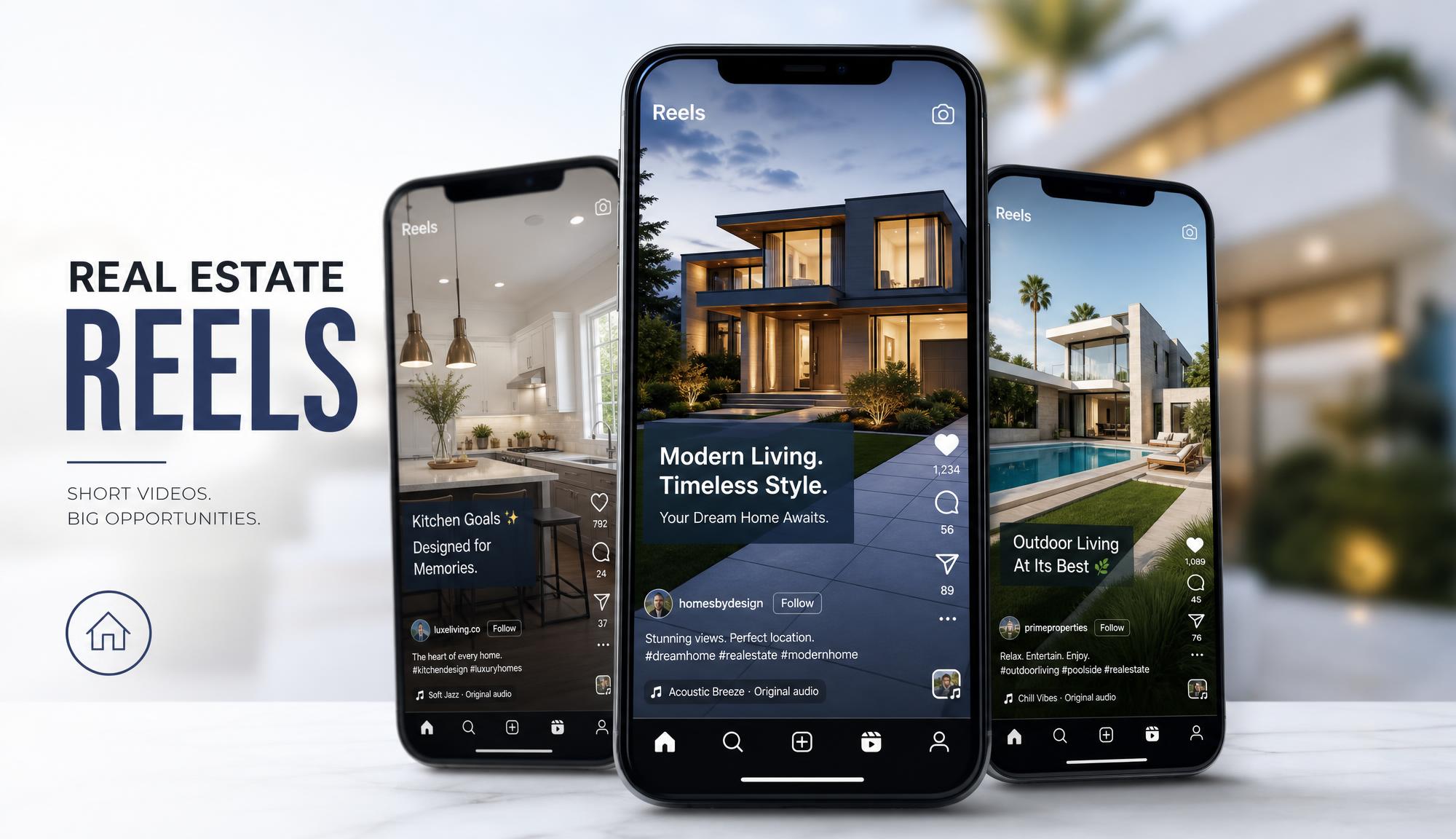
A real estate Reel is not a short listing video. It is a video built for a feed that decides within one second whether to keep showing it to anyone. That distinction changes almost every production decision: how you open, how long you hold each shot, where you put text, and what you ask for at the end.
This guide covers the current Instagram Reels specifications, the three ranking signals Instagram has publicly confirmed, five script structures with timestamps, 25 hooks you can use today, and 30 Reel ideas. It also covers the part most guides skip: how to produce the footage when you did not film anything. If you are building a wider social plan around these, start with our real estate social media strategy.
What changed for real estate Reels in 2026
Three shifts matter for agents, and all three point in the same direction: distribution now depends on whether people finish and share your video, not on how many followers you have.
Sends became the strongest signal. Adam Mosseri has confirmed, in January 2025, that Instagram ranks Reels primarily on watch time, likes relative to reach, and sends relative to reach. Sends carry disproportionate weight, because a share is a costlier action than a like. For a listing video this is good news: property content is inherently shareable between a couple, a parent and an adult child, or an agent and a client.
Follower count stopped gating reach. Reels are distributed heavily to non-followers, which is why a 300-follower agent can out-reach a 30,000-follower brokerage account on a single video. The trade-off is that every Reel is judged on its own merit. There is no coasting.
Polish stopped being an advantage on its own. Instagram has been explicit that unpolished, authentic content is not penalised, and in 2026 heavily produced content that reads as an advertisement tends to underperform. This does not mean bad footage wins. It means a clean, well-paced listing video with a human hook beats a glossy brand film with no opening.
Instagram Reels specs for real estate in 2026
Most Reels that look soft or get their text cropped fail on one of these. Set them once and stop thinking about it.
Specs verified September 2026 against Instagram's Reels documentation. Meta changes these regularly — re-check before relying on them.
The safe-zone numbers are the ones agents get wrong most often. A price or address placed at the very bottom of the frame sits underneath the interface. Keep every word you need read inside the middle band.
How Instagram decides who sees your Reel
Three signals do most of the work. Every production choice below traces back to one of them.
A practical consequence: a 20-second Reel that 70 percent of viewers finish will out-distribute a 60-second Reel that 20 percent finish, even though the second one holds more total attention per viewer. Optimise for completion first, length second.
Five Reel structures that work for listings
Every high-performing real estate Reel is a version of one of these five. Timestamps are the working defaults, not rules.
1. The single-feature Reel (15 seconds)
The highest-completion format, and the one most agents skip because it feels too small. One feature, one payoff.
- 0 to 1 s — Hook on screen and spoken: the feature as a claim. "This pantry is bigger than my first apartment."
- 1 to 4 s — Establishing shot of the room that holds the feature.
- 4 to 12 s — Two or three shots of the feature itself, closest shot last.
- 12 to 15 s — Price, city, and one instruction. "Full tour in my bio."
2. The fast walkthrough (25 to 35 seconds)
The default listing Reel. The discipline is pacing: eight to twelve shots, none longer than three seconds.
- 0 to 1 s — Hook with a number. "$625,000 in Tempe and it has a casita."
- 1 to 3 s — Exterior or hero shot.
- 3 to 25 s — Room by room, best room second rather than last, so the payoff lands before drop-off.
- 25 to 32 s — The one detail worth remembering.
- 32 to 35 s — Call to action.
3. The before and after (20 seconds)
The strongest send-rate format in real estate, because the transformation is the shareable object. Works for renovations, physical staging, and virtual staging.
- 0 to 2 s — The "before" held long enough to register as bad.
- 2 to 3 s — Hard cut on the beat to the "after".
- 3 to 15 s — Three or four "after" shots.
- 15 to 20 s — What it cost or how long it took. Specificity is what gets it sent.
If the transformation is virtual staging rather than physical, the staged image has to be labelled. Our guide to AI virtual staging disclosure laws covers what the label has to say and where it has to sit.
4. The neighbourhood Reel (30 seconds)
Builds the local authority that listing Reels alone never will. No property required, which means you can shoot it once and post it for years.
- 0 to 2 s — A claim about the area. "Three coffee shops within walking distance of this street."
- 2 to 24 s — Three or four locations, five seconds each, name on screen.
- 24 to 30 s — Connect it to housing. "Median here is $480,000. Ask me what that buys."
5. The market answer (20 to 30 seconds)
Talking head to camera answering one question you actually get asked. This is the format that produces saves and sends from people who are not ready to move yet.
- 0 to 2 s — The question, stated as the hook. "Should you wait for rates to drop before buying?"
- 2 to 20 s — A direct answer with one number in it.
- 20 to 25 s — The caveat that makes it credible.
- 25 to 30 s — "Send this to whoever is arguing with you about it."
25 hooks you can use today
The first line does more work than everything after it. These are structures, not scripts. Fill in your own numbers and the specificity does the rest.
Price and value hooks
- "$450,000 in [city]. Here is what that gets you now."
- "This costs less per month than the two-bedroom you are renting."
- "Three houses, same price, three very different lives."
- "The cheapest house on the block is not the one you think."
- "$1.2 million and the best part is not the house."
Curiosity hooks
- "The seller almost did not let us photograph this room."
- "There is a door in this kitchen that nobody expects."
- "This house has been on the market for 94 days. I know why."
- "Wait for the backyard."
- "Nobody puts this in a listing photo, so I will."
Problem hooks
- "Your house is not overpriced. It is under-photographed."
- "Buyers are not skipping your listing. They never saw it."
- "Three things in this photo are costing you offers."
- "You do not have a pricing problem. You have a first-weekend problem."
- "If your listing has 12 photos and no video, this is for you."
Local authority hooks
- "Everyone moving to [city] asks about this neighbourhood. Here is the honest version."
- "The three streets I would buy on in [city], and one I would not."
- "[City] has a school district line that moves prices by $80,000."
- "Where locals actually eat in [neighbourhood]."
- "I have sold 40 homes in this zip code. Here is what I would tell my own family."
Format hooks
- "Rate this kitchen out of ten. I will go first."
- "Same house. Two years apart."
- "POV: you get the keys on Friday."
- "Things in this listing that should not be legal."
- "Tell me your budget and I will tell you your street."
30 real estate Reel ideas
When the calendar is the bottleneck rather than the editing, work from this list. Each one maps to a structure above.
Listing content (10)
- Full walkthrough of a new listing
- A single standout room
- Before and after staging
- The detail that sold it
- Price reveal at the end
- Twilight exterior
- What $X buys in your market this month
- A tour shot entirely in one continuous move
- Just sold, with days on market
- Open house invitation with the three rooms worth the drive
Local and lifestyle (10)
- Neighbourhood coffee tour
- Best parks for families
- A day in this suburb
- Commute times from three areas
- School district explainer
- Restaurants within walking distance
- What the area looks like in each season
- Local business owner interview
- Farmers market walkthrough
- Where to watch the sunset in your city
Authority and education (10)
- Explain escrow in 30 seconds
- Three costs first-time buyers forget
- What an inspection actually finds
- How to read a comparative market analysis
- Why your Zestimate is wrong
- What earnest money is and when you lose it
- The offer term that beats a higher price
- How long selling actually takes
- One question to ask every agent you interview
- What you should never say to a listing agent
For the strategy layer around these — cadence, platform mix, and what to repurpose — see our social media strategy guide.
How to make the video when you did not film anything
This is the actual bottleneck. Most agents know what a good Reel looks like. What stops them is that a Reel requires footage, and the listing shoot produced photos.
Amplifiles exists to close that gap. You upload the listing photos you already have, pick a one-click animation for each one, and the clips combine into a finished video. There are more than 30 one-click effects across six categories: camera moves such as push in, drone up and rotate; ambient motion such as a flickering fireplace or rippling pool water; timelapses; Time of Day shifts that turn a flat midday exterior into golden hour; special effects such as the Magazine and Newspaper treatments built for social; and start and end image animations.
Quick Animations cost $1.50 per image at a flat rate, and each clip runs up to five seconds. A listing Reel built from eight to fifteen photos costs $12 to $22.50 on pay-as-you-go, or $8 to $15 on a subscription, and renders in about five minutes. Export in 9:16 and it is ready to post.
There is one step worth taking every time. Add an AI voice-over and Amplifiles generates the captions automatically from it, burned into the video, at no extra cost. That single toggle solves the sound-off problem described below, and it is the difference between a Reel that reads in a silent feed and one that does not.
For the moments that need more than a camera move, Creative Mode adds custom VFX clips: virtual staging to furnish an empty room, added people for a lifestyle scene, AI close-ups that frame a detail from the description alone, and speed ramps. Those bill at $0.30 per second plus $0.20 per image edit. The pattern most users land on is Quick Animations for everything and Creative Mode for the two or three moments that carry the video.
One workflow note specific to Reels. The before-and-after structure is the strongest send-rate format on the list, and virtual staging plus a start and end image animation produces it directly: animate from the empty room to the staged room in a single clip. See real estate video examples for delivered videos next to their source photos.
Captions, hashtags, and sound
Captions
Write the first line as if the rest is hidden, because it is. Instagram truncates after roughly 125 characters. Put the hook there, the detail after, and the instruction last. Two useful patterns: state the price and city in the first line for listing Reels, or ask the question the video answers for educational ones.
Burn on-screen text into the video as well. A large share of Reels are watched without sound, and the on-screen line is the only thing carrying the hook for those viewers. Keep it inside the safe zones.
Captions are not optional in 2026. They lift completion rate on every format in this guide, and completion rate is the input that drives distribution. If you are building the Reel from listing photos in Amplifiles, adding an AI voice-over generates the captions for you automatically and costs nothing extra, so there is no reason to publish a listing Reel without them.
Hashtags
Three to five relevant tags is the working range. Volume stopped helping years ago, and Instagram now leans on the caption text and on-screen words to classify a Reel. Mix one broad tag, two local tags, and one format tag: #realestate #austinrealestate #austinhomes #hometour. Local tags do more for an agent than any national tag ever will, because they reach the only audience that can transact with you.
Sound
Sound is a compliance decision as much as a creative one. Trending audio from the Instagram library helps distribution on organic Reels, but tracks in that library are licensed for organic use only. The moment you want to put budget behind a Reel, a licensed trending track will block the boost or get the ad rejected.
If there is any chance you will promote the video, build it with music from the Meta Sound Collection from the start. Re-editing a Reel after it performs is a poor use of a good week. Our real estate Facebook ads guide covers what happens to the creative once you put money behind it.
Posting cadence and the metrics that matter
Three to five Reels a week is the range where accounts compound without burning out. Below two, the account never builds momentum. Above seven, quality drops and the average completion rate falls, which hurts the whole account.
Post when your own audience is active rather than following a generic best-time chart. Instagram shows this under Insights, and for most agents it lands in the evening on weekdays. Schedule natively in the app; third-party schedulers no longer carry any distribution penalty, but native scheduling avoids format re-encoding.
Ignore follower growth as a primary metric. An agent with 1,200 engaged local followers writes more business than one with 15,000 scattered across the country.
Tools for making real estate Reels, compared
Four categories of tool, and most agents end up using two of them.
The split most agents settle on: a photo-to-video tool for listings, and a mobile editor for anything shot on a phone. The two do not overlap much, and neither replaces the other.
Frequently asked questions
How long should a real estate Reel be?
Fifteen to forty-five seconds is the working range for a listing. Instagram accepts much longer — the camera now records up to 20 minutes — but it does not recommend Reels over three minutes to new audiences, so length past that costs you reach. Completion rate matters more than length: a 20-second Reel that most viewers finish will out-distribute a 60-second Reel that most viewers abandon.
Can I make real estate Reels without filming anything?
Yes. Tools that animate listing photos produce Reel-ready vertical clips from the images you already shot for the MLS. Amplifiles applies camera moves, ambient motion and lighting shifts to each photo at $1.50 per image and renders a finished video in about five minutes, exported in 9:16 for Reels. Adding an AI voice-over also generates burned-in captions automatically at no extra cost.
What size should a real estate Reel be?
9:16 vertical at 1440 by 2560 pixels, 30 frames per second minimum, MP4 with H.264 video and AAC audio. Keep text and logos out of the top 14 percent, the bottom 35 percent, and 6 percent on each side, because the interface covers those areas.
How often should real estate agents post Reels?
Three to five a week. Consistency matters more than volume, because each Reel is ranked on its own performance and a run of weak posts lowers the account average. Two strong Reels beat five rushed ones.
Do hashtags still work on Instagram Reels?
They help classify the video but they are no longer a growth lever on their own. Three to five relevant tags is the working range, weighted toward local ones. Instagram leans more on caption text and on-screen words to understand what a Reel is about.
Can I use trending audio on a real estate Reel?
On organic Reels, yes, and it helps distribution. If you intend to put ad budget behind the video, use the Meta Sound Collection instead: trending tracks are licensed for organic use only, and a boosted Reel with licensed music will be blocked or rejected.
Do real estate Reels need captions?
Yes. Most Reels are watched with the sound off, so the on-screen text is what carries the hook and holds the viewer past the first second. Captions raise completion rate, and completion rate is one of the three signals Instagram ranks on. If you build the Reel from listing photos in Amplifiles, adding an AI voice-over generates the captions automatically at no extra cost.
What makes a real estate Reel get shared?
A single clear idea and a reason to send it to a specific person. Before-and-after transformations and price-reveal Reels get the highest send rates, because the viewer has an obvious person in mind. Sends relative to reach is one of the three signals Instagram confirms it ranks on.
Final thoughts
The agents who win on Reels are not the ones with the best cameras. They are the ones who post consistently with a strong first second, one idea per video, and a reason to share. Every specification in this guide exists to protect those three things.
The production step is the one that stops most people, and it does not have to. Amplifiles turns the listing photos you already have into vertical video clips in about five minutes at $1.50 per image, with no filming and no editing software. Add an AI voice-over and the captions are generated for you, included in the price. New accounts get 1,200 free credits and no card is required. Browse real estate video examples to see the output first, or review the full pricing before you spend anything.