.webp)


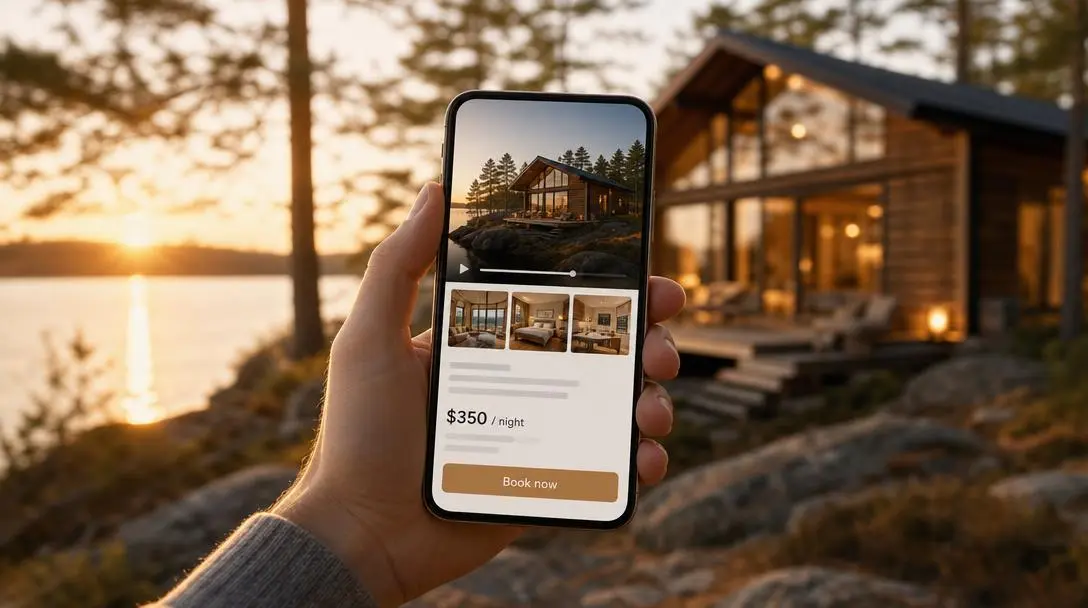
Yes, video sells vacation rentals, and the strongest proof does not come from travel. It comes from e-commerce, where retailers like Zalando and Amazon have tested video against photos on millions of product pages. The best controlled result shows video lifting sales by 14.5%, and Zalando's own A/B tests put the gain at around 3% of gross merchandise value.
A vacation rental listing works almost exactly like a product page. Guests scroll a grid of thumbnails, open a gallery, and decide without ever touching the thing they are buying. This article walks through what the e-commerce data actually shows, which numbers hold up and which do not, and what it means if you market one rental or two hundred. It sits alongside our real estate marketing guide, which covers the wider picture.
Is a vacation rental listing really like an e-commerce product page?
Mostly, yes. Look at how a guest books a cabin on Vrbo and how a shopper buys a jacket on Zalando. Both start with search and filters. Both scan a grid where one thumbnail and a price decide the click. Both land on a detail page with a photo gallery, a description, reviews and a big button. And in both cases the buyer cannot try the product first. Nobody test sleeps in a rental before paying.
The costly failure mode is the same too. In fashion, the product that looked different online comes back as a return, and returns eat margin. In short-term rentals there is no return, but there is its cousin: the guest who arrives, feels the place is smaller or darker than the photos suggested, and says so in a review. Airbnb even scores accuracy as its own review category. A mismatch between expectation and reality costs a retailer a shipping label. It costs a rental a star rating that sits on the listing for years.
There are three real differences, and they matter for how you use video:
- The platform owns the page. Zalando decides what a product page can show. So do Airbnb and Vrbo, and their rules on video are very different (more on that below).
- Every unit is one of a kind. A retailer shoots one video and sells ten thousand identical jackets. A property manager needs a separate video for every door, which is why cost per video decides whether video happens at all.
- The ticket is bigger and the decision slower. A week in a lake house costs more than most online orders, so guests compare longer and look harder at the gallery. That favors whichever format answers their questions fastest.
So the analogy holds where it counts: the booking decision is made from a screen, on media alone. That is exactly the situation e-commerce has spent a decade measuring.
What e-commerce has actually measured about video
A lot of "video increases conversions by 80%" numbers float around marketing blogs. Most come from companies that sell video tools and cannot be traced to a test. We went looking for the results that come from controlled experiments or from the platforms' own data, and graded each one on how much weight it can carry.
| Source | What was measured | Result | How much to trust it |
|---|---|---|---|
| Kumar and Tan, Management Science (2015) | Videos added to randomly chosen apparel on a fashion retailer's site | +14.5% apparel sales, +28.3% sales of accessories shown in the video | High. Randomized field experiment, peer reviewed |
| Zalando A/B tests (reported 2026) | Product pages with video vs without | About +3% GMV | High. Controlled test at huge scale |
| Amazon internal data (H1 2026) | Pages after adding their first shoppable video | +24% average sales; apparel +30.5%, home +26.7% | Medium. Platform data, not randomized |
| Zalando (2024) | Shoppers who saw video vs only images | 3x more likely to buy, fewer returns | Low as an effect size. Viewers are already keener buyers |
The cleanest result is the oldest one. In 2015, researchers Anuj Kumar and Yinliang Tan added videos to a few randomly selected garments on a fashion retailer's website. Because the products were picked at random, the difference in sales can be credited to the video itself and not to the retailer choosing its best sellers.
Zalando is the company that turned this into a strategy. It calls video, 3D and styled imagery "elevated content", and says that content gets 10% higher engagement than standard product shots. In November 2025 it opened product page video to its marketplace partners, and it has shared A/B test results showing a GMV uplift of around 3% on pages with video. Three percent sounds small until you remember it is measured across one of Europe's largest fashion stores, where it adds up to a very large amount of money.
Amazon's number is bigger and softer. It reports that product pages which added their first shoppable video saw an average 24% increase in sales in the first half of 2026, with apparel at 30.5% and home products at 26.7%. That is a before and after comparison published by a platform that wants sellers to make more video, so treat it as a ceiling, not a forecast.
Be careful with the figure you will see quoted most, Zalando's "3x more likely to buy". It compares people who watched a video with people who did not, and people who press play are already more interested. It shows that video and purchase intent travel together. It does not show video tripling sales.
The honest summary: controlled tests put the lift from video somewhere between 3% and 15%, and platform data suggests it can run higher. Anyone promising 80% is selling something.
The vacation rental evidence already points the same way
Nobody has run a randomized video test across thousands of rentals and published it. But there are closely related results from Airbnb and from one of the largest vacation rental managers in the US, and together they are some of the best evidence the industry has about media and bookings.
Researchers from Carnegie Mellon and other universities tracked 7,423 Airbnb properties over 16 months. Listings that switched from host photos to professional photos from Airbnb's own program saw 8.98% higher occupancy than comparable listings that did not. The properties did not change. The media did, and bookings moved with it.
The closest thing to a direct test on a rental portfolio comes from Vacasa. It added Matterport 3D tours to almost 90% of its listings and reports a nearly 12% increase in rental bookings between September 2019 and September 2021, with tour listings browsed three times longer. A 3D tour is not a video, but it answers the same question a photo cannot: how the rooms fit together. Read the number the way you read Amazon's. It is a case study published by the vendor, not a controlled experiment. Still, it lands close to the 14.5% from the randomized fashion test.
Put the findings side by side. In rentals, better media alone raised occupancy by about 9%, and adding a way to move through the space came with roughly 12% more bookings. In e-commerce, adding motion on top of good photos raised sales by another 3% to 15% in controlled tests. The step from good photos to video is the same step Zalando is taking, applied to a product that is harder to judge from a still image than a jacket is. A photo of a living room cannot show that the kitchen opens onto it, that the terrace is two steps from the sofa, or that the "sea view" is a real sea view.
That last point is also why video tends to reduce the rental version of a return. A 2022 study on product presentation videos found that video raises perceived diagnosticity, the sense of knowing what you are actually getting. Guests who know what they are getting do not feel misled on arrival. We have written more on this mechanism in the psychology behind why video persuades buyers.
One caution deserves a mention, and Airbnb data backs it up. Several of the researchers behind the occupancy study followed 958 Manhattan Airbnb listings for a year and found that high quality photos pulled in more guests at first, but when the property did not live up to them, guests left bad reviews or none at all, and future demand fell. E-commerce sees the same pattern: a 2025 study of livestream shopping found that overly persuasive video increased returns. Video that shows the property accurately protects your reviews. Video that oversells it does the opposite. Show the real place.
Where a vacation rental video can actually run
This is where the e-commerce analogy bends. Zalando controls its own product pages. Hosts and property managers work across several platforms, each with its own rulebook.
- Airbnb: standard listings have no video slot. You can still use video everywhere around Airbnb, which we cover in Airbnb marketing without a listing video.
- Vrbo: accepts listing videos after review. Its video guidelines ask for 15 seconds to 2 minutes, prefer portrait, allow voice-overs and captions, remove added music, and say a video cannot be "a series of still images in a slideshow or montage."
- Booking.com: its partner help center documents video for verifying a property's location, not as a gallery feature on the listing.
- Your direct booking site: no rules but yours. This is the closest thing a rental business has to a Zalando product page, and the one place you can run a proper test.
- Social and paid ads: vertical video is the default format on Instagram, TikTok and Facebook, and it is where most guests first see a property before searching for it.
On the Vrbo slideshow rule: Vrbo's reviewers make the final call. In practice, video built by animating listing photos with real camera movement already clears human review elsewhere, since videos made this way are accepted on Idealista, which runs its own preview check on uploaded listing videos. If a reviewer ever pushes back, vary the camera moves and cut any shot with minimal movement.
The part e-commerce solved first: cost per video
Zalando's real breakthrough was not proving that video works. It already knew that. The breakthrough was making video cheap enough to give to every product. Traditionally you could not shoot a video for every SKU, so video went to the hero products and everything else got photos. Zalando now uses AI to turn standard product imagery into video-like content in hours, and around half of its campaign content is built with AI.
Property managers face the same math, only harder, because every door is its own SKU. If video costs a videographer visit per property, it goes to the three flagship villas and the other forty units stay photo only. The e-commerce data says that is exactly backwards: the lift comes from coverage, not from a handful of showpieces.
The fix is the one Zalando found. Start from the photos you already have. Amplifiles turns a listing's photos into a 1080p video with camera movement, captions and an optional voice-over in about 5 minutes. It costs $1.50 per image (one dollar and fifty cents), so a 12 photo rental video comes to $18. There is no shoot day and no guest calendar to block. You can see finished results on our real estate video examples page, and our property management marketing guide works through what video costs across a full portfolio.
How to test it on your own portfolio
The most useful thing to copy from Zalando is not the video. It is the A/B test. If you manage more than a handful of units, you can measure this yourself instead of trusting anyone's statistic, including ours.
- Pair your units. Match properties by market, size, price band and review score. Put one from each pair in a video group and one in a control group.
- Add video only to the video group, everywhere it is allowed: Vrbo, your direct site, and the social posts that promote each unit.
- Track three numbers for 60 to 90 days: listing views to booking requests on Vrbo, booking conversion on your direct site, and the accuracy score in reviews.
- Compare the groups, not the before and after. Seasons move bookings more than any video does. The control group tells you what would have happened anyway.
If the video group converts better, roll video out to every door. If it does not, you have spent very little finding out. Either way you will have a number that belongs to your market, which beats any figure in this article.
Frequently Asked Questions
Do videos increase vacation rental bookings?
The best evidence says yes, by a moderate amount. Controlled e-commerce tests show video lifting sales by 3% to 15%, and an Airbnb study found that better listing media alone raised occupancy by 8.98%. No large randomized video test on rentals has been published, so testing on your own units is the most reliable way to size the effect.
Why compare vacation rentals to e-commerce?
Because the buying decision works the same way. Guests choose from a thumbnail grid, judge a product they cannot touch from a gallery, and punish mismatches, shoppers with returns and guests with low accuracy ratings. E-commerce has run far more controlled tests on photos versus video, so its results are the best available guide.
Can I add a video to my Airbnb listing?
Not to a standard Airbnb listing, which supports photos only. Vrbo accepts listing videos between 15 seconds and 2 minutes after review, and you can use video freely on your direct booking site, social media and ads.
How much does a vacation rental video cost?
A videographer visit typically costs hundreds of dollars per property and needs a free day in the calendar. Amplifiles makes a video from the listing photos you already have for $1.50 per image, so a 12 photo video costs $18 and takes about 5 minutes. New accounts get 1,200 free credits, enough for one video from about 8 photos.
Final Thoughts
E-commerce did not move to video because it looked modern. It moved because controlled tests kept showing more sales and fewer disappointed buyers, and because AI finally made video cheap enough for every product. A vacation rental listing is a product page with a bigger ticket and a harder product to judge from a photo. The same logic applies, and the same cost problem now has the same solution.
We built Amplifiles so every listing can have a video, not just the flagship ones. Our platform turns listing photos into professional 1080p marketing videos in about 5 minutes, with voice-overs, captions, and branding. No filming or editing required.
Browse real estate video examples to see what a finished video looks like, or make your first rental video free with 1,200 free credits. Managing a larger portfolio? Our done-for-you video service handles the editing for you.