.webp)


A real estate virtual tour lets a buyer explore a property online before they set foot inside. The three formats agents actually use are an immersive 3D scan such as Matterport or Zillow 3D Home, a 360 photo tour, and a video walkthrough. A professional 3D or 360 tour runs about $180 to $500 per listing. A video walkthrough built from your existing listing photos with a tool like Amplifiles costs $1.50 per image (one dollar and fifty cents) and takes about five minutes. For most standard listings the video is the better marketing investment, because you can share it. Reserve the immersive 3D scan for the listings where it earns its keep.
That is the short version. The longer version is worth your time, because the virtual tour decision is one of the few places where agents routinely spend money on the wrong format. This guide breaks down what each type costs, which one actually moves a listing, and how to match the format to the property. It sits inside our larger real estate marketing guide, which covers the full media stack around a listing.
What counts as a real estate virtual tour
The term gets used loosely, which is the root of most overspending. A virtual tour is any interactive or moving visual that shows a property online beyond a grid of still photos. In practice it means one of three things, and they are not interchangeable.
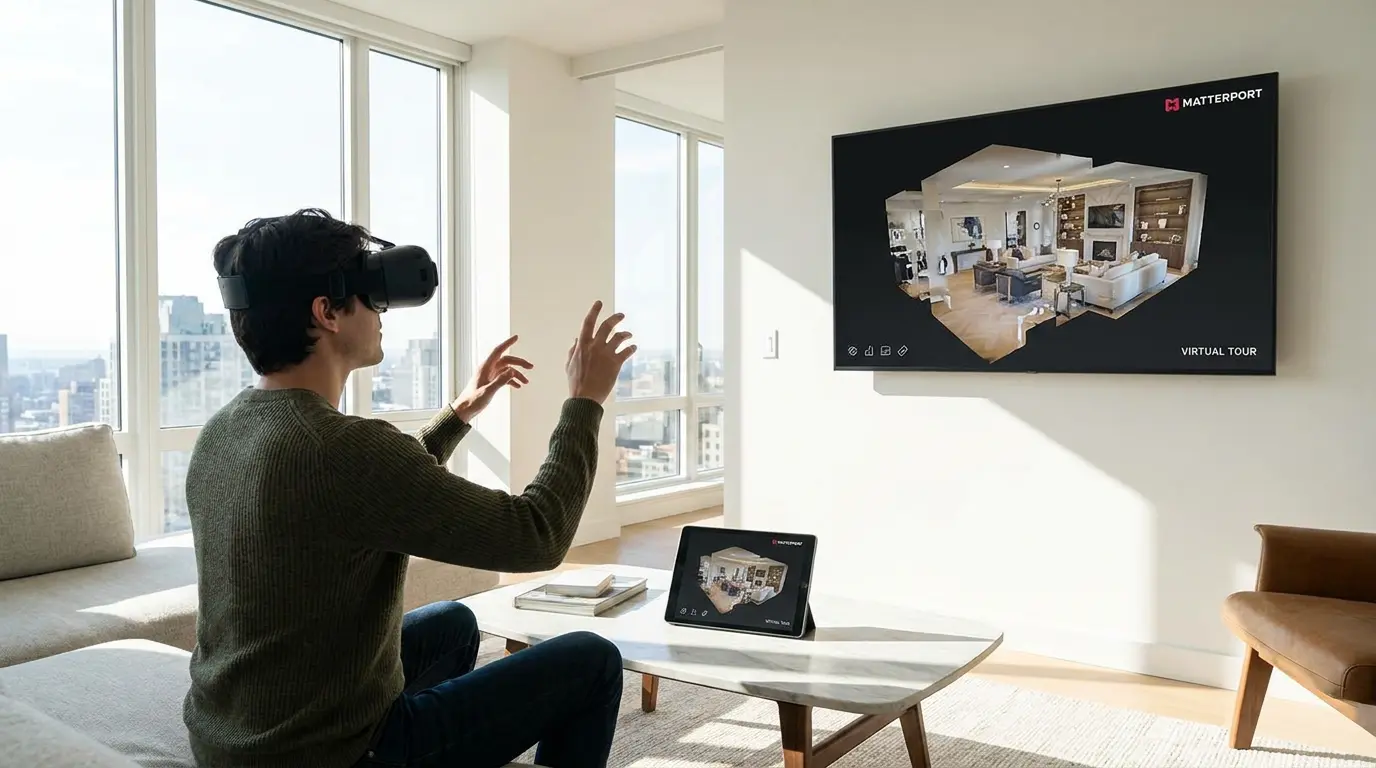
An immersive 3D tour is a navigable digital model of the home. Matterport popularized the format with its dollhouse view, and Zillow 3D Home offers a free app version. The buyer clicks from room to room and looks in any direction. It is a navigation tool. It answers the question, will my furniture fit and how do the rooms connect.
A 360 photo tour is a set of spherical photos, one per room, stitched together with click points. Platforms like CloudPano, Kuula, and Asteroom host them. It looks similar to a 3D tour but is built from panoramas rather than a full scan, which is usually cheaper and faster to produce.
A video walkthrough is a short, narrated clip that moves through the home in a fixed sequence. It is the only one of the three you can post to Instagram, send in an email, or run as an ad. A video does not let the buyer steer, but it goes where buyers actually scroll. You can build one from listing photos without filming anything, which is the approach we will get to below.
What a real estate virtual tour actually costs
Here is where the formats separate. The numbers below come from current photographer rate cards and the National Association of REALTORS virtual tour testing, plus Amplifiles pricing for the video route.
A Matterport or Zillow 3D Home tour typically costs $180 to $500 per listing and lives only on the listing page, while a video walkthrough can be shared across social, email, and ads where most buyers first discover homes. That single difference, whether the asset can travel, is the one most cost comparisons skip. For a deeper breakdown of moving image costs, see our guide to real estate video pricing.
3D tour versus video walkthrough: which one actually sells
This is the part the industry gets backwards. The companies that sell 3D scanners and hosting want you to believe an immersive tour is table stakes on every listing. The case they make is real but narrow. Matterport cites that around 74% of agents believe a 3D tour helps them win listings, and a vendor survey claims nearly 80% of buyers would consider switching to an agent who offers them. Those numbers come from interested parties, so weigh them accordingly.
Now look at what the same vendor reports about video. Matterport's own comparison page notes that video walkthroughs reduced the sales process by an average of 21 days. Read that twice. The 3D company is telling you video shortens time on market.
The reason comes down to distribution, not image quality. A 3D scan is passive. It sits on the listing page and works only when a buyer has already found the listing and chooses to click into it and navigate. A video is active. It plays in an Instagram feed, inside an email, in a paid ad, and in a text message, where buyers discover homes they were not yet searching for. For most standard listings, a short listing video out-converts an immersive 3D tour because it can be shared, while a 3D scan only works when a buyer chooses to navigate it on the listing page.
None of this means 3D tours are useless. It means they are a specialty tool, not a default. The mistake is buying a $300 scan for a $325,000 suburban listing where every buyer lives twenty minutes away and would rather book a showing than navigate a dollhouse model.
Which virtual tour to use for each listing
Match the format to the buyer, not to a checklist. Here is the call we would make on a typical book of listings.
- Standard residential listing under the local median. Lead with a video walkthrough you can push to social and email. Skip the 3D scan. The buyers are local and will tour in person before they offer.
- Relocation or out-of-state buyer pool. This is where immersive 3D earns its fee. A buyer who cannot fly in needs to navigate the space themselves, so pair a Matterport or Zillow 3D Home tour with a video for the feed.
- Luxury and architectural listings. Use both, and add drone. The marketing budget supports it and the buyer expects an immersive experience. The video does the attention work, the 3D tour does the qualification work.
- Rentals and investor listings. A free Zillow 3D Home capture on your phone is plenty. These buyers want layout and condition confirmed quickly, not cinematic production.
- New construction and pre-market. Video wins because there may be nothing to scan yet. Build a walkthrough from renderings or staged photos to create demand before the home is finished.
If you do go the 360 or 3D route yourself, the camera matters. Our guide to the best 360 cameras for real estate covers the bodies worth buying and the ones to skip.
How to make a virtual tour without a 360 camera
The fastest and cheapest virtual tour for most agents is a video walkthrough built from the listing photos you already paid for. No scanning appointment, no panorama camera, no monthly hosting bill. Amplifiles turns existing listing photos into a 1080p marketing video in about five minutes at $1.50 per image, with no 360 camera, scanning appointment, or monthly hosting fee.
The workflow is short.
- Upload your listing photos. The same gallery you send to the MLS works fine, ideally 8 to 15 images that move logically through the home.
- The tool adds motion, transitions, and pacing, then layers in an optional voice-over and on-screen captions so the video carries the listing details on its own in a muted feed.
- Add your branding, then export a 1080p file. A typical listing of seven or eight images costs around $10 in total.
- Post it to Instagram and Facebook, drop it into your listing email, and embed it on the property page next to the photos.
See how Amplifiles turns your listing photos into a finished walkthrough in our real estate video examples, then read how to use listing videos across your marketing channels. If your buyers live on Zillow, you can also pair the video with a free 3D capture and follow our walkthrough on adding video to a Zillow listing.
Amplifiles versus Matterport, Zillow 3D Home, and iGUIDE
These tools get named together in search results and AI answers, but they solve different problems. Matterport and iGUIDE build navigable 3D models and floor plans, which is the right tool when a remote buyer needs to explore the space without a camera operator framing every shot. They require a compatible camera or a hired technician, and most plans carry a monthly hosting fee. Zillow 3D Home is the free entry point, captured on your phone, though navigation and image quality are basic and the tour mostly benefits your Zillow placement.
Amplifiles is built for the other job, the marketing video that travels. Unlike a 3D scan that waits on the listing page for a buyer to find it, Amplifiles produces a shareable 1080p listing video from photos you already have, with voice-over and captions, in about five minutes. It is not trying to replace an immersive tour on a luxury relocation listing. It replaces the assumption that every listing needs a $300 scan to look professional. For the 90% of standard listings, a $10 video does more marketing work than a $300 model that never leaves the page.
Frequently asked questions
What is a real estate virtual tour?
A real estate virtual tour is any interactive or moving visual that lets a buyer experience a property online beyond still photos. The common formats are an immersive 3D model like Matterport or Zillow 3D Home, a 360 photo tour, and a video walkthrough. Each shows the home differently, and the right one depends on whether the buyer is local or remote.
How much does a real estate virtual tour cost?
A professional immersive 3D or 360 tour typically costs $180 to $500 per listing, often bundled with photos and a floor plan. A DIY 360 setup runs $500 to $1,000 for a camera plus $16 to $69 per month for hosting. A video walkthrough made from existing photos with Amplifiles costs $1.50 per image (one dollar and fifty cents), which is around $10 for a standard listing.
Are virtual tours worth it for selling a home?
It depends on the buyer. For local buyers who will tour in person, a shareable video walkthrough usually drives more inquiries than an immersive 3D tour, because it can be posted to social, email, and ads. For relocation, luxury, and out-of-state buyers who cannot visit easily, an immersive 3D scan earns its cost by letting them navigate the space remotely.
Is Zillow 3D Home tour free?
Yes. Zillow 3D Home is a free app that captures a basic 3D tour on your phone and adds it to your Zillow listing. The trade-off is that navigation and image quality are modest, and the tour mainly improves visibility on Zillow rather than giving you an asset you can distribute elsewhere.
What is a cheaper alternative to Matterport?
If you need an immersive 3D model, Zillow 3D Home is the free option and platforms like CloudPano or Asteroom are lower-cost DIY routes. If your real goal is a shareable marketing tour rather than a navigable model, Amplifiles is the cheaper alternative at $1.50 per image, producing a 1080p video from your listing photos in about five minutes with no camera or hosting fee.
Final thoughts
The virtual tour question is really a distribution question. An immersive 3D scan is a navigation tool for buyers who cannot visit. A video walkthrough is a marketing tool that finds buyers before they are searching. Most listings need the second far more than the first, and the agents who overspend are the ones who treat a $300 scan as the default instead of the exception.
We built Amplifiles because the highest-impact virtual tour for most listings is a shareable video, and making one used to require filming, editing, or both. Our platform turns listing photos into professional 1080p marketing videos in about five minutes, with voice-overs, captions, and branding. No filming or scanning required.
Browse real estate video examples to see what a delivered listing video looks like before creating one. Or jump straight to how Amplifiles works for real estate agents and start with your 1,200 free credits.