.webp)


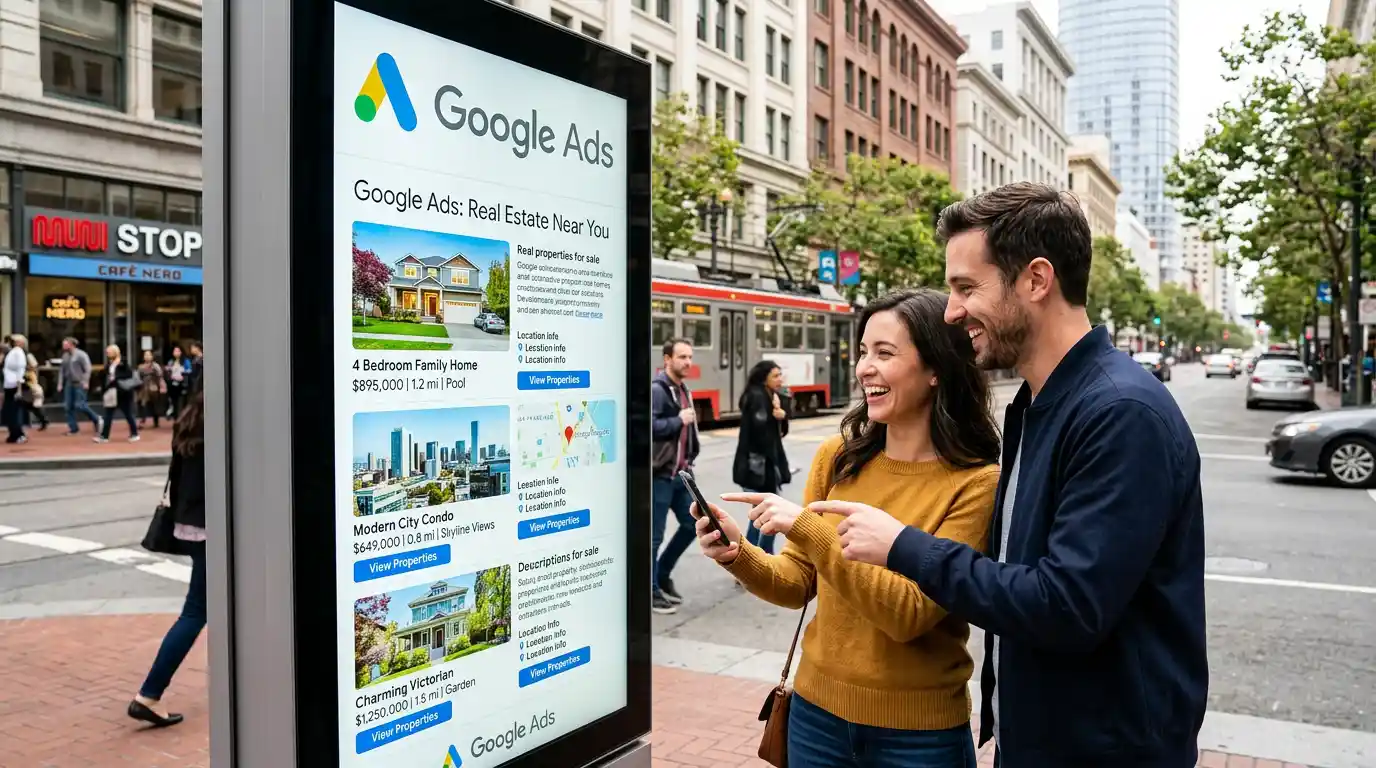
Most real estate Google Ads do not fail because of the keywords. They fail because the click lands on a homepage or a bare IDX search page that asks the visitor to do everything and offer nothing. At an average cost per click well north of $20 for many agent terms, every wasted click is money you do not get back. This guide covers how to structure buyer and seller campaigns separately, what to actually budget, the negative keywords that protect your spend, and the single landing page change that moves cost per lead more than any bid tweak: putting a listing video on the page.
If you want the organic side of search handled too, pair this with our guide to local SEO for real estate agents. Paid search buys you the top of the page today. Local SEO earns it for free over time. The smartest agents run both.
Do Google Ads actually work for real estate agents?
Yes, but only when the campaign is built around intent and the landing experience is built around one decision. Google Ads put you in front of someone at the exact moment they search "homes for sale in [your area]" or "what is my house worth." That timing is the whole point. The problem is that real estate is one of the most expensive categories on Google, so there is no room for a sloppy funnel.
The agents who lose money on Google Ads usually make the same three mistakes. They bid on broad terms like "real estate" and pay for tire kickers. They send every click to one generic page. And they follow up slowly, if at all. Fix those three and the math starts working. Ignore them and you are just funding Google.
Separate your buyer and seller campaigns
Buyers and sellers are two different businesses that happen to share a license. They search differently, they convert on different offers, and they cost very different amounts per click. Running them in one campaign is the fastest way to waste budget, because Google will spend wherever clicks are cheapest, not where your money is best spent.
Seller keywords like "what is my home worth" and "sell my house fast" are usually more expensive per click, but a single listing is worth far more in commission than a single buyer lead. Buyer keywords are cheaper and higher volume, but the lead quality is mixed and the timeline is longer. You want to control the budget for each on purpose, not let the algorithm blend them.
The negative keyword list that protects your budget
Negative keywords are the single highest-leverage setting in a real estate account, and most agents never touch them. Without them, Google happily spends your money on searches that will never become a client. Add these as negatives on day one, then review your search terms report every week and keep adding.
- Rental terms: rent, rentals, for rent, apartments, lease, section 8, tenant
- Job and license terms: jobs, salary, how to become a real estate agent, real estate license, exam, courses
- Free and DIY terms: free, FSBO, for sale by owner, zillow, redfin, realtor.com (unless you specifically target competitor conquesting)
- Investor and wholesale terms: wholesale, cash for houses, we buy houses, foreclosure list (unless that is your niche)
- Information-only terms: real estate definition, what is escrow, market report (these are researchers, not buyers)
One caveat. A negative keyword is only "wasteful" relative to your business. If you run a rental-focused team, "for rent" is your money keyword, not a negative. The point is to exclude everything outside the exact business you are paying to win.
What should you actually spend?
The honest answer is that a budget too small to gather data will just lose money slowly. A common rule is to fund at least 10 to 20 clicks per day so the campaign has enough signal to optimize. If your buyer terms run around $5 per click, that is $50 to $100 a day. If you are bidding on competitive seller terms at $15 or more per click, the floor is higher. Starting at $5 a day on expensive terms does not make you cautious. It makes you invisible.
Here is the part the generic guides skip. Once your budget is set, your cost per lead is decided almost entirely by your landing page conversion rate, not your bid. Watch what happens to the same $1,500 monthly budget as the landing page improves.
The numbers above are illustrative, assuming roughly 300 clicks a month at a $5 blended cost per click. The point is not the exact figures. It is the shape. Same spend, same traffic, and the cost per lead drops fivefold purely from the page the click lands on. You cannot bid your way to that improvement. You have to earn it on the page.
The landing page is where real estate Google Ads are won or lost
Every competing guide tells you to send clicks to a dedicated landing page instead of your homepage. True, but incomplete. A dedicated page with a stock hero photo and a long form is still a weak page. What actually lifts conversion is message match and proof, and nothing delivers both faster than a short listing video.
When someone clicks an ad for "homes for sale in Maple Grove" and lands on a page that opens with a real video tour of a Maple Grove listing, three things happen at once. The visitor sees you deliver exactly what they searched for. They stay on the page longer, which Google reads as a quality signal. And they get a reason to trust you before they fill out a form. Adding a listing video to a Google Ads landing page is one of the few changes that lifts conversion rate without raising your cost per click, because it improves both engagement and message match.
This is the gap most agents cannot close, because producing a video for every campaign sounds expensive and slow. It is not anymore. Amplifiles is an AI real estate video maker that turns listing photos into a branded 1080p video in about 5 minutes at $1.50 per image (one dollar and fifty cents per image). That price and speed are what make a per-campaign, per-listing video realistic instead of a luxury you save for your best listing. See real estate video examples to picture what lands on the page.
If you want the wider context on why video earns attention, the real estate video statistics every agent should know back up the pattern with data, and our video marketing guide for agents shows where else the same video earns its keep after the ad campaign ends.
Search Ads or Local Services Ads?
They solve different problems, and serious agents often run both. Local Services Ads sit at the very top of the page with a Google Screened badge, and you pay per lead instead of per click. They are excellent for capturing "real estate agent near me" demand with built-in trust. Standard Search Ads give you control over specific buyer and seller keywords and where the click goes, which is exactly the control you need to run the campaign structure above.
A simple way to split them. Use Local Services Ads to win agent-intent searches where someone wants a person. Use Search Ads for the offer-driven campaigns where you want to capture a valuation request or a listing inquiry on a page you control. Local Services Ads cannot send traffic to a video landing page. Search Ads can, which is where the conversion advantage lives.
Track leads, not clicks, and follow up in minutes
If you only track clicks, Google will optimize for clicks and you will get plenty of cheap, worthless ones. Install conversion tracking for form fills, phone calls, and valuation requests so the algorithm learns what a real lead looks like. Then know your numbers: cost per lead, cost per appointment, and cost per closed transaction. Those three tell you whether to scale or shut a campaign off.
One more thing the budget cannot fix: speed to lead. A paid lead that waits an hour for a callback is often already talking to another agent. Set up an automatic text the moment a form is submitted, then call within minutes. The campaign gets you the lead. The follow-up decides whether you keep it.
Frequently Asked Questions
Do Google Ads work for real estate agents?
Yes, when the campaign targets high-intent buyer and seller keywords and sends clicks to a focused landing page rather than a homepage. Real estate is an expensive category, so the funnel has to be tight. Agents who track real leads, exclude wasteful searches with negative keywords, and follow up fast can make the math work consistently.
How much should a real estate agent spend on Google Ads?
Enough to gather data, which usually means funding at least 10 to 20 clicks per day. For cheaper buyer terms that can be $50 to $100 a day. For competitive seller terms at $15 or more per click, the floor is higher. A budget too small to produce daily clicks will lose money slowly without ever learning what works.
Why am I getting clicks but no leads from Google Ads?
This is almost always a landing page problem, not a keyword problem. If clicks land on a homepage or a bare IDX search page with no single clear offer, most visitors leave without converting. Send each campaign to a dedicated page with one offer and add a listing video to lift conversion. A tool like Amplifiles produces a 1080p listing video from photos in about 5 minutes, which makes a video landing page practical for every campaign.
What are the best Google Ads keywords for real estate?
Local, intent-driven terms tied to a clear offer. For buyers that means phrases like "homes for sale in [neighborhood]" and "[city] real estate agent." For sellers it means "what is my home worth" and "sell my house fast [city]." Avoid broad terms like "real estate," which attract researchers and job seekers and burn budget.
Are Local Services Ads better than Search Ads for agents?
They serve different goals. Local Services Ads charge per lead and win agent-intent searches with a Google Screened badge of trust. Search Ads charge per click but let you control keywords and send traffic to a landing page you design, including one with a listing video. Many agents run both and let Local Services Ads handle "agent near me" demand while Search Ads run the offer campaigns.
Final Thoughts
Real estate Google Ads are not magic and they are not a scam. They are a fair trade: you pay for attention at the moment of intent, and your job is to convert that attention before the meter runs out. The keyword gets the click. The negative keywords protect the budget. The landing page, and the video on it, decide whether you get a lead or a lesson.
We built Amplifiles because the slowest, most expensive part of running ads used to be producing the video that makes the page convert. Our platform turns listing photos into professional 1080p marketing videos in about 5 minutes, with voice-overs, captions, and branding, at $1.50 per image. No filming or editing required.
Browse real estate video examples to see what a delivered listing video looks like before you create one. Or see how Amplifiles works for real estate agents and start with your 1,200 free credits, which cover roughly eight images.