.webp)


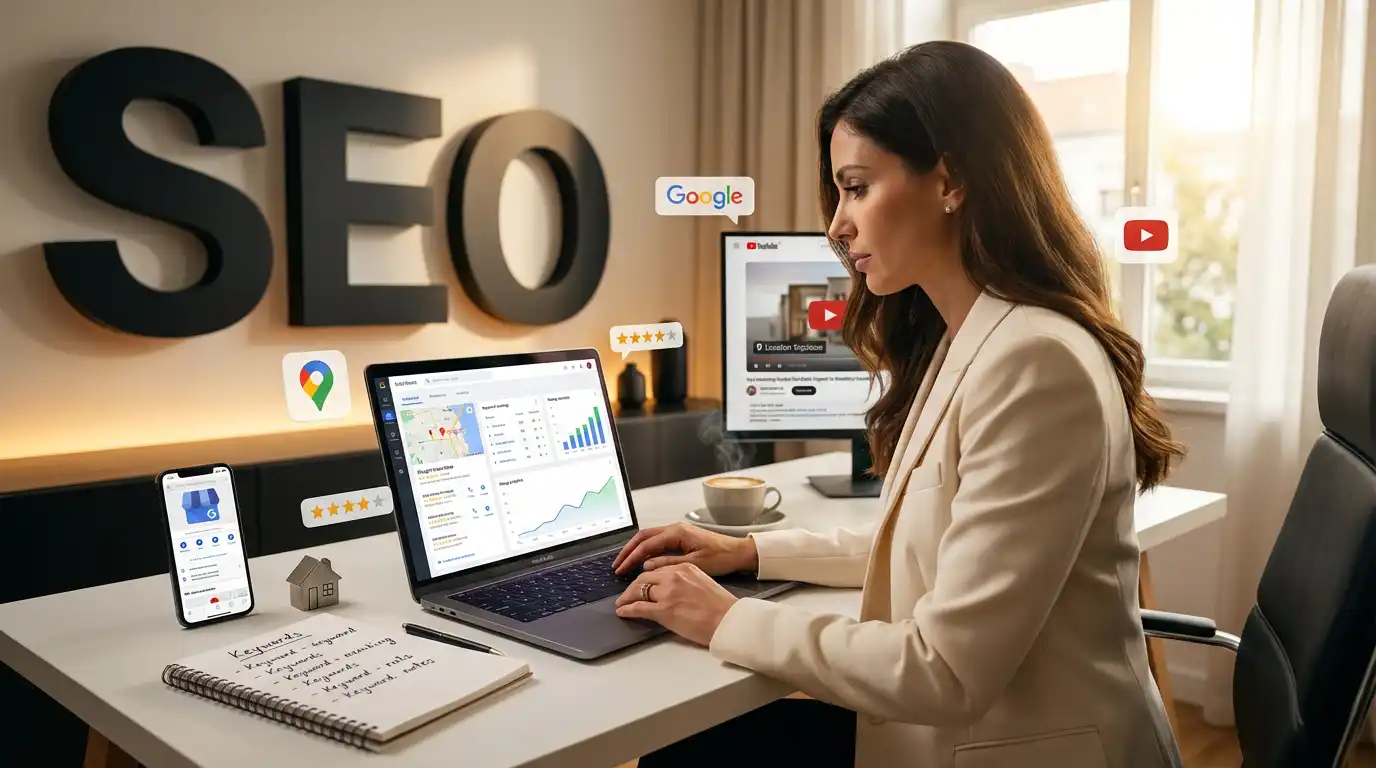
Local SEO for real estate agents is how you show up when a buyer or seller searches "real estate agent near me," "homes for sale in [your neighborhood]," or "best realtor in [your city]." It combines Google Business Profile optimization, neighborhood-level content, local keyword targeting, citation consistency, and reviews. The agents who win in 2026 do one more thing that almost nobody else does: they treat listing videos as a local SEO signal, because Google owns YouTube and neighborhood searches increasingly trigger video carousels and AI Overviews that cite video content.
This guide is for working agents, not SEO consultants. Every recommendation below is either a lever you can pull this week with zero budget, or a system that compounds for months after you set it up. We will cover how Google's local algorithm actually scores agents, the four categories of work that move rankings, where listing video fits into the picture (most competitors will not even mention this), and a 30-day plan you can start tomorrow.
Why local SEO beats generic SEO for agents
Real estate is a hyper-local business. The keyword "real estate agent" gets 33,000 searches a month in the US, but ranking nationally for it is effectively impossible and would not matter if you could, because a buyer in Austin has no use for an agent in Boston. The keywords that convert for agents are geographic: "real estate agent in [city]," "homes for sale in [neighborhood]," "[school district] real estate agent." These have lower volume individually but far higher commercial intent, weaker competition, and a clear local pack opportunity.
There are three surfaces you are competing for on a local search:
- The Google Map Pack. The boxed set of 3 local business listings that appears above organic results. These come from Google Business Profile signals.
- Local organic results. Standard blue links, but ranked with heavy local intent modifiers. Your website matters here.
- AI Overviews and featured snippets. Increasingly the first thing a buyer sees. These pull from the top few organic results and structured content.
Most agents only optimize for one surface, which is why a small amount of focused work can push you past competitors who have been in the market longer. Treat these three surfaces as three separate ranking jobs that share the same underlying signals.
How Google's local algorithm actually works
Google uses three core factors for local results: relevance, distance, and prominence. Understanding what each one means in practice is the difference between random tactics and a repeatable system.
Relevance is how closely your business matches what the searcher is looking for. If your Google Business Profile says "Real Estate Agency" and your website talks about luxury waterfront homes in Tampa, you are relevant to "Tampa luxury real estate agent." Relevance is driven by your business category, the content on your website and profile, your service area, and the keywords that appear in your reviews and posts.
Distance is how far your business location is from the searcher (or from the location mentioned in the query). You cannot change your office location easily, but you can define a service area on your Google Business Profile and publish neighborhood-specific content that signals you actually cover those areas.
Prominence is how well known and trusted your business is. This is where citations, backlinks, reviews, and brand mentions add up. It is also where video comes in, because YouTube views, video embeds, and VideoObject schema are prominence signals that most agents have never used.
Every tactic below maps to one of these three levers. If a "local SEO tip" does not clearly move relevance, distance, or prominence, it is a distraction.
Google Business Profile is the biggest single lever
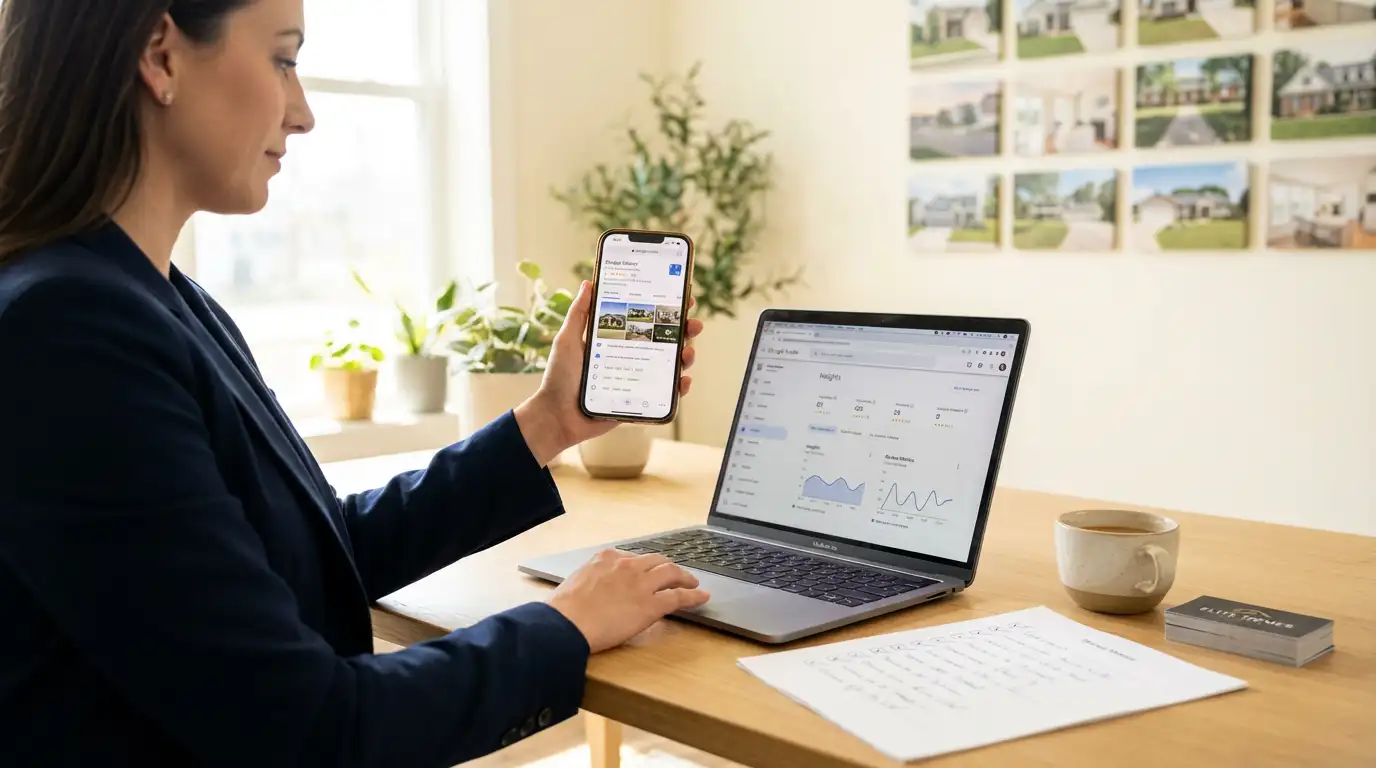
If you do nothing else on this list, fix your Google Business Profile. It is the single biggest influence on whether you show up in the Map Pack, and roughly 42% of local real estate searches result in a click from the Map Pack rather than the organic results below it.
Work through this list in order:
- Claim and verify your profile. Use a postal address if you work from home, not a PO Box. Google verifies by postcard or video.
- Set the primary category to "Real Estate Agent" (not "Real Estate Agency" unless you own the brokerage). Add secondary categories like "Real Estate Consultant" or "Property Management Company" only if they genuinely describe what you do.
- Write a business description that is 700 to 750 characters, mentions the neighborhoods and property types you cover, and reads like a human wrote it. Do not keyword-stuff. Google penalizes obvious manipulation.
- Add every service you offer as a separate service item with its own description. "First-Time Home Buyer Consultation" and "Luxury Home Sales" should be separate entries, not lumped into one.
- Set accurate hours and keep them current. An agent who closes the profile on weekends when buyers are actually searching is handing leads to competitors.
- Upload at least 20 photos and add new ones monthly. Profiles with 100+ photos get significantly more calls and direction requests than profiles with fewer than 10. Geotag them if your camera app supports it.
- Post weekly. Google Posts are underused. A short update about a new listing, a neighborhood insight, or a closed sale keeps your profile fresh and signals activity.
- Add videos. This is where most competitors stop and where you get your edge. A listing video embedded in a Google Post gets significantly more clicks than a photo post, and video content on your profile is a prominence signal.
Video posts on Google Business Profile are a real estate agent's most underused asset. Most agents think they need a production crew to make one. They do not. Amplifiles turns listing photos into a branded 1080p video in about 5 minutes for $1.50 per image (one dollar and fifty cents), which means a 7-photo listing walkthrough costs $10.50 and fits inside a Google Post without filming anything yourself.
Neighborhood pages: where most agents are losing
Generic "homes for sale in [city]" pages on agent websites are almost always thin, templated, and scraped from MLS feeds. They do not rank, because every competitor has the exact same page. The agents who do rank build real neighborhood pages: one URL per neighborhood or zip code, each with unique content that a local buyer would actually read.
A strong neighborhood page includes:
- A genuinely written overview of the neighborhood (300 to 500 words). What it is known for, the commute picture, the school district, typical housing stock, recent market dynamics.
- Current active listings in that neighborhood, ideally embedded from your MLS.
- A recent market snapshot: median price, days on market, months of inventory, updated quarterly.
- An embedded neighborhood video. This can be a walkthrough of a current listing, a short "day in the life" clip, or a video montage of recent sales. This is the signal that separates ranking pages from invisible ones.
- Local links out to the city's official page, the school district, the chamber of commerce. These outbound links tell Google your page sits inside a real local web.
- A CTA to book a call or get on an alerts list.
The video on a neighborhood page does two jobs at once. First, it keeps users on the page longer, and Google measures dwell time. Pages with embedded video hold a searcher on the page for roughly 2.6 times longer than pages with only text. Second, it makes the page eligible for video-rich results: video thumbnails in the SERP, video carousels on mobile, and potential inclusion in AI Overviews that pull from multimodal content.
Most agents skip video because they cannot produce one per neighborhood. You can, because you already have listing photos.
Video schema: the local SEO lever almost nobody uses
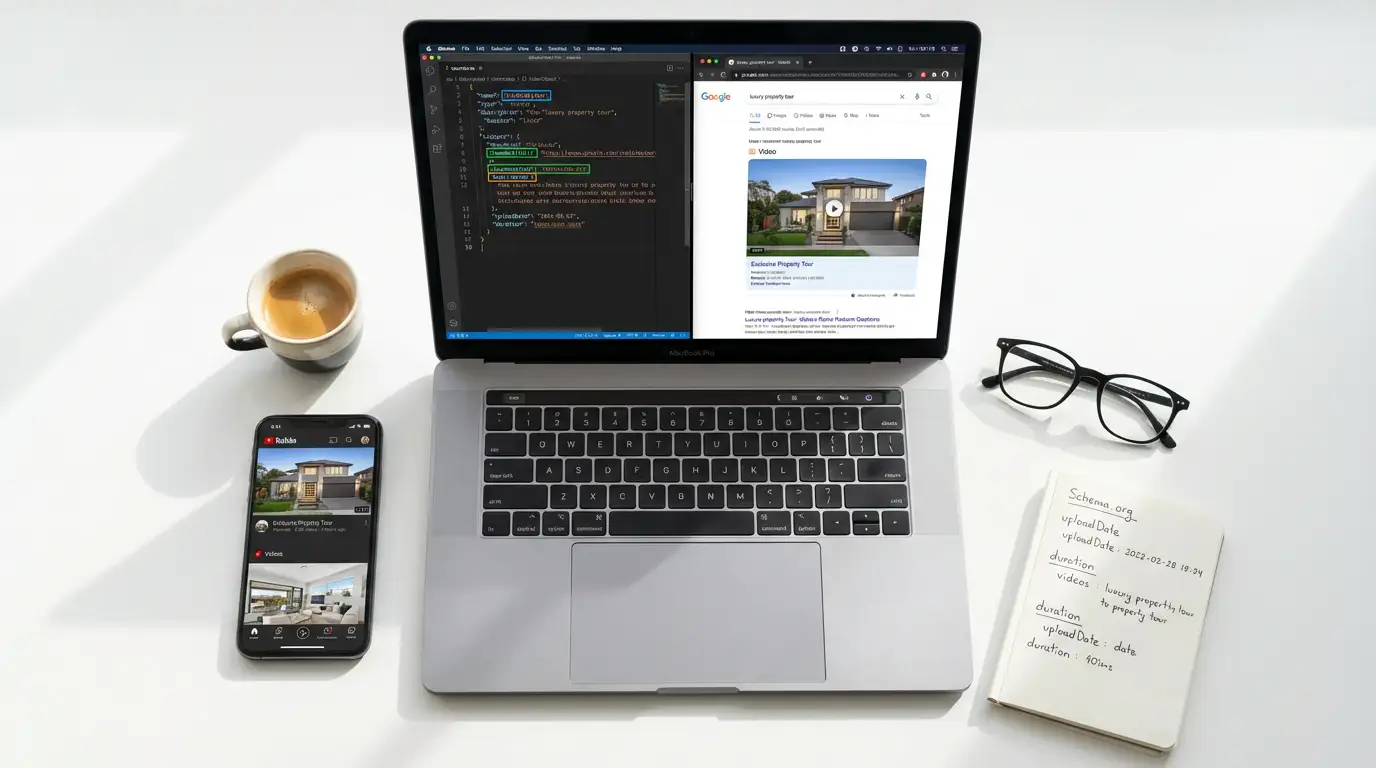
Every video on your site should be wrapped in VideoObject schema markup. This tells Google exactly what the video is, who made it, how long it is, and what it is about. Without it, Google can show the video in search, but the rich results are far less likely.
A basic VideoObject schema block looks like this conceptually: name, description, thumbnail URL, upload date, duration, and content URL. Any developer can add it in 10 minutes, and plenty of website platforms generate it automatically when you embed a video properly. If you are using Wix, Squarespace, or a real estate IDX platform, check the video embed settings for "structured data" or "SEO metadata."
Here is the compounding effect: a neighborhood page with a ranked Google Business Profile, a unique written overview, a listing video with schema, and inbound links from local sites can rank for dozens of long-tail queries ("4-bedroom homes in [neighborhood]," "[neighborhood] school district real estate," "homes for sale near [local landmark]") without any of them being your primary target. That is the "video advantage" local SEO playbook.
Our full guide to real estate video SEO covers the schema details, YouTube optimization, and thumbnail strategy in depth if you want to go further on this specific lever.
Local keyword strategy that actually works
Most local keyword advice is bad because it assumes you should rank for high-volume head terms. You should not, at least not first. Head terms like "real estate agent [big city]" are dominated by Zillow, Realtor.com, Redfin, and the largest brokerages. No independent agent is outranking those with a blog.
Instead, target the three layers of local keyword intent in order:
- Hyper-local long-tail. "Townhouses for sale in [specific neighborhood]," "homes near [specific elementary school]," "[zip code] real estate." These have 30 to 300 monthly searches, but they convert at 5 to 10 times the rate of head terms because the intent is exact.
- Buyer-question queries. "Is [neighborhood] a good place to live," "cost of living in [city] 2026," "[neighborhood] vs [neighborhood] for families." These are top-of-funnel, but they establish you as the local expert before a buyer is ready to list. AI Overviews love question-based content.
- Transactional modifiers. "Best real estate agent in [city]," "[neighborhood] listing agent," "sell my house fast in [city]." These are the ones competitors are all chasing. You rank for them after you have built authority on the first two layers, not before.
Use Google Keyword Planner, Google Search Console (look at the queries your site already gets impressions for), and the "People Also Ask" box on real Google searches to build your list. You do not need paid SEO tools to get started.
Citations, backlinks, and reviews (the prominence stack)
Prominence is the hardest of the three ranking factors to move because it requires other sites to vouch for you. Three categories matter:
Citations are consistent mentions of your Name, Address, and Phone (NAP) across directories: Yelp, Bing Places, Apple Maps, Zillow agent profiles, Realtor.com, local chamber directories, niche real estate sites. Inconsistent NAP is a common source of invisible ranking loss. Audit yours with a free tool like Moz Local or BrightLocal once, fix the mismatches, and check quarterly.
Local backlinks are links from other local websites: the local newspaper, community associations, school PTAs, local businesses you refer clients to. One link from a local .gov or .edu site beats fifty generic blog comment links. The fastest path: sponsor a small local event, offer your office as a meeting space, get interviewed on a local podcast.
Reviews are both a ranking factor and a conversion multiplier. Aim for a minimum of 20 Google reviews with an average of 4.7 stars or higher, and request reviews systematically after every closing. Respond to every review, good or bad. Google reads the keywords in reviews and in your responses, so when a client mentions the neighborhood name in their review, that is a free local SEO signal.
A systematic approach to reviews and referrals is covered in more depth in our guide on how to find customers for real estate, which walks through the lead generation side of the same work.
AI Overviews and AEO: the new local search layer
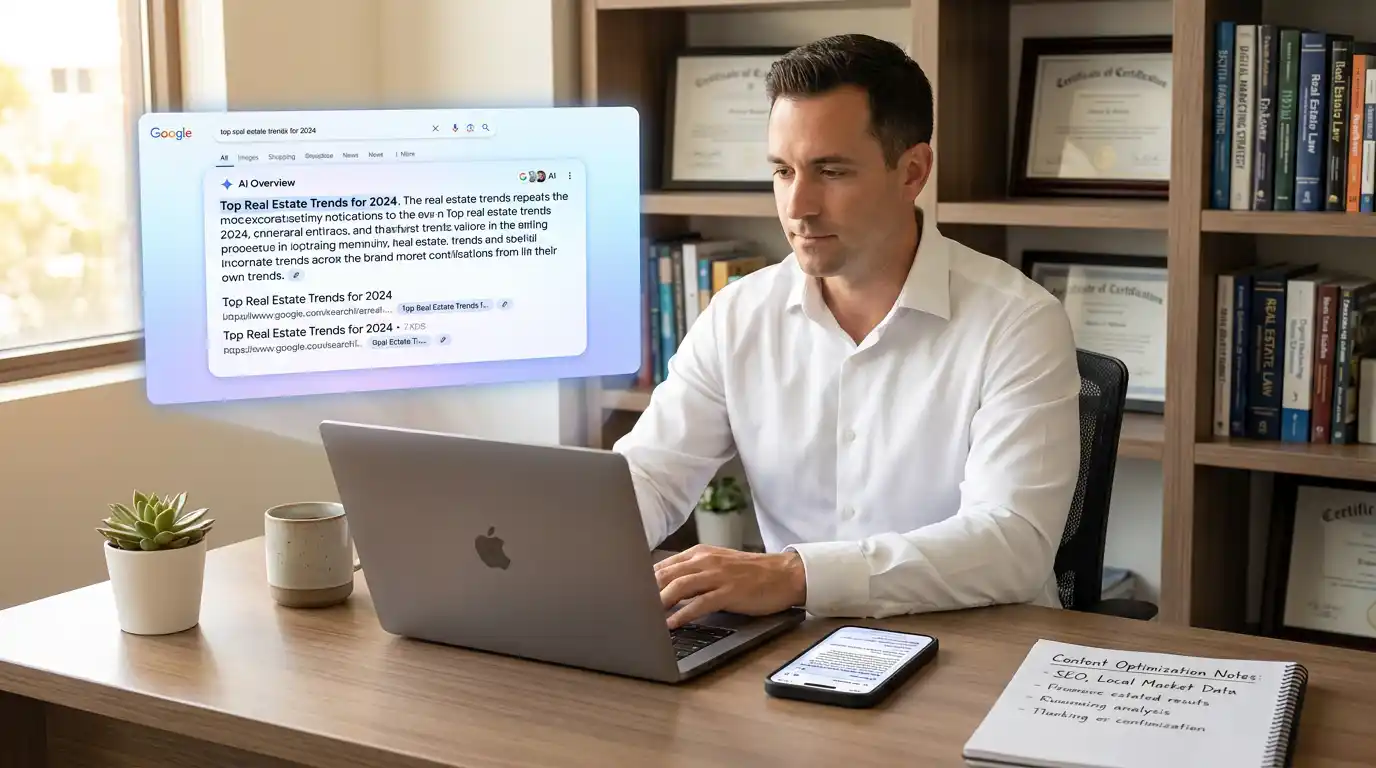
Google AI Overviews now appear above the Map Pack on roughly 30% of real estate queries, and ChatGPT, Perplexity, and Claude answer thousands of "real estate agent in [city]" questions every day. Answer Engine Optimization (AEO) is no longer optional for local real estate.
Three tactics move the needle:
- Structured, scannable answers. Use clear H2 and H3 headings, definition-style opening paragraphs, and numbered lists. AI engines extract from structured content because it is easier to parse.
- First-party data. Include specific local statistics: median prices, days on market, recent sale trends in your neighborhoods, your own performance data. AI Overviews prefer unique data over rehashed content.
- Named entity clarity. Mention your business name, the neighborhoods you cover, and your specific services clearly throughout your content. AI models cite entities they can identify confidently.
The video angle shows up again here. AI Overviews increasingly cite pages that include video, because those pages are interpreted as higher-quality resources. A neighborhood page with a current listing video, unique market data, and clear structure is far more likely to be cited than a text-only page, even if both contain the same information.
The 30-day local SEO plan
This is not a strategy doc. It is a sequence of tasks you can execute in 30 days, working 30 to 45 minutes a day. Skip anything you have already done.
Week 1: Foundation.
- Day 1-2: Claim and fully complete your Google Business Profile. Primary category, business description, service area, hours, contact info.
- Day 3: Upload 20 photos to your profile (properties, headshots, office, team, neighborhood shots).
- Day 4: Audit NAP consistency across Yelp, Bing, Apple Maps, Realtor.com, Zillow, and the local chamber.
- Day 5: Write and publish your first Google Post. Target a recent listing or a neighborhood update.
- Day 6-7: Set up review requests. Email every client from the last 12 months with a direct Google review link.
Week 2: Content.
- Day 8-9: Pick your three highest-priority neighborhoods. Draft a 400-word unique overview for each.
- Day 10-11: Produce a listing video for each neighborhood. If you have current listings, use those photos. If not, use photos from recent sales or a representative home. With an AI listing video maker, each one takes about 5 minutes.
- Day 12: Publish the three neighborhood pages with the videos embedded, VideoObject schema, and outbound links to local resources.
- Day 13-14: Post each neighborhood video to your Google Business Profile as a Google Post.
Week 3: Citations and backlinks.
- Day 15-16: Submit your business to the top 20 real estate and local directories (Yelp, BBB, Chamber, Nextdoor, Trulia, Zillow, Realtor.com, etc.).
- Day 17-18: Identify 5 local link opportunities: a local blog, the community association, the chamber, a neighboring non-competing business, the school district PTA.
- Day 19-20: Reach out to all 5 with a specific, useful pitch (guest article, local resource page inclusion, cross-promotion).
- Day 21: Add your listing videos to YouTube with neighborhood-optimized titles, descriptions, and chapters. Each one becomes a standalone ranking asset.
Week 4: Compounding.
- Day 22-23: Write one neighborhood "is this a good place to live" question-style blog post. Aim for 1,200 words and include the listing video.
- Day 24-25: Follow up on review requests. Aim to clear 10+ new Google reviews.
- Day 26-27: Add one more neighborhood page. Repeat the format.
- Day 28-30: Measure. Check your Google Business Profile views, website organic traffic to neighborhood pages, and ranking positions for your target local keywords. Document what moved.
After 30 days you will have 4 ranked neighborhood pages with video, a complete and active Google Business Profile, 10+ fresh reviews, directory consistency, and at least 2 local backlinks. That is enough to outrank most independent agents in your market within another 60 to 90 days as the signals age in.
Where listing video fits into the bigger picture
Video is not the only local SEO tactic, but it is the one that separates agents who plateau at position 5 to 10 from agents who hold the Map Pack. Most competitors cannot produce video at the pace neighborhood SEO requires, because it means $300 to $800 per listing and a week of turnaround.
Amplifiles is an AI-powered real estate video maker that turns listing photos into branded 1080p marketing videos in approximately 5 minutes. Videos include voice-over, captions, and your branding. Pricing is $1.50 per image (one dollar and fifty cents), which means a 7-image listing video costs $10.50 and a full neighborhood set of 6 listings runs about $60. New users get 1,200 free credits (roughly 8 images) to try the platform.
This is the economic shift that makes a video-first local SEO strategy possible. You are no longer choosing between SEO content and video content. You can ship both from the same listing photos in the same afternoon.
Frequently asked questions
How long does local SEO take for a real estate agent?
Most agents see early movement in Google Business Profile views within 2 to 4 weeks, meaningful organic traffic growth within 60 to 90 days, and stable Map Pack rankings within 4 to 6 months of consistent work. The bulk of the compounding comes from accumulated reviews, aging backlinks, and published neighborhood pages, so starting now is always better than waiting.
Does local SEO still work in 2026 with AI Overviews dominating search?
Yes. AI Overviews pull from the same signals that drive local rankings: authoritative pages, structured content, clear entities, local backlinks, and Google Business Profile data. Agents who optimize for local SEO are also optimizing for AI Overview citations by default, because the underlying quality signals overlap. Video and unique data make you more citable, not less.
What is more important, Google Business Profile or website SEO?
Google Business Profile for Map Pack visibility, website SEO for organic and AI Overview visibility. The biggest mistake agents make is treating them as separate projects. Your Google Business Profile should link to your website, your website should have current content, and both should tell a consistent story about the neighborhoods and services you cover.
Can I do local SEO without a blog?
Partially. You can optimize your Google Business Profile, build citations, collect reviews, and get local backlinks without ever writing a blog post. But you will cap out at the top of the Map Pack without organic authority. Neighborhood pages and question-style content are what push you into page-one organic results, and those require written content. The good news: 10 to 15 well-built pages usually beat a blog of 100 thin posts.
How do I add video to my local SEO strategy without hiring a videographer?
Use an AI real estate video maker. Amplifiles turns your existing listing photos into a branded 1080p video in about 5 minutes at $1.50 per image. You can produce a neighborhood video, a listing walkthrough, or a market update video in the same time it takes to write a Google Post. Embed the video on your neighborhood page with VideoObject schema, post a clip to your Google Business Profile, and upload the full version to YouTube with a geo-targeted title.
What are the best tools for auditing local SEO for real estate?
For NAP and citation consistency: Moz Local or BrightLocal (both have free starter tiers). For keyword tracking: Google Search Console is free and essential. For rank tracking on local Map Pack positions: Local Falcon or GeoRanker. For Google Business Profile insights: use the built-in Google Business Profile dashboard, it is often overlooked but shows exactly which queries trigger your listing.
Start ranking locally this month
Local SEO is the highest-ROI marketing channel for an independent real estate agent in 2026, because it compounds. Every review, every backlink, every neighborhood page stays live and keeps ranking for years after you publish it. The agents who start now will be outranking everyone who waits.
If you want to add video to your local SEO strategy without hiring a production team, start with 1,200 free credits from Amplifiles. Turn your listing photos into a branded neighborhood video in the time it takes to drink a coffee, embed it on your next neighborhood page, and give Google one more reason to rank you above every text-only competitor in your market.