.webp)


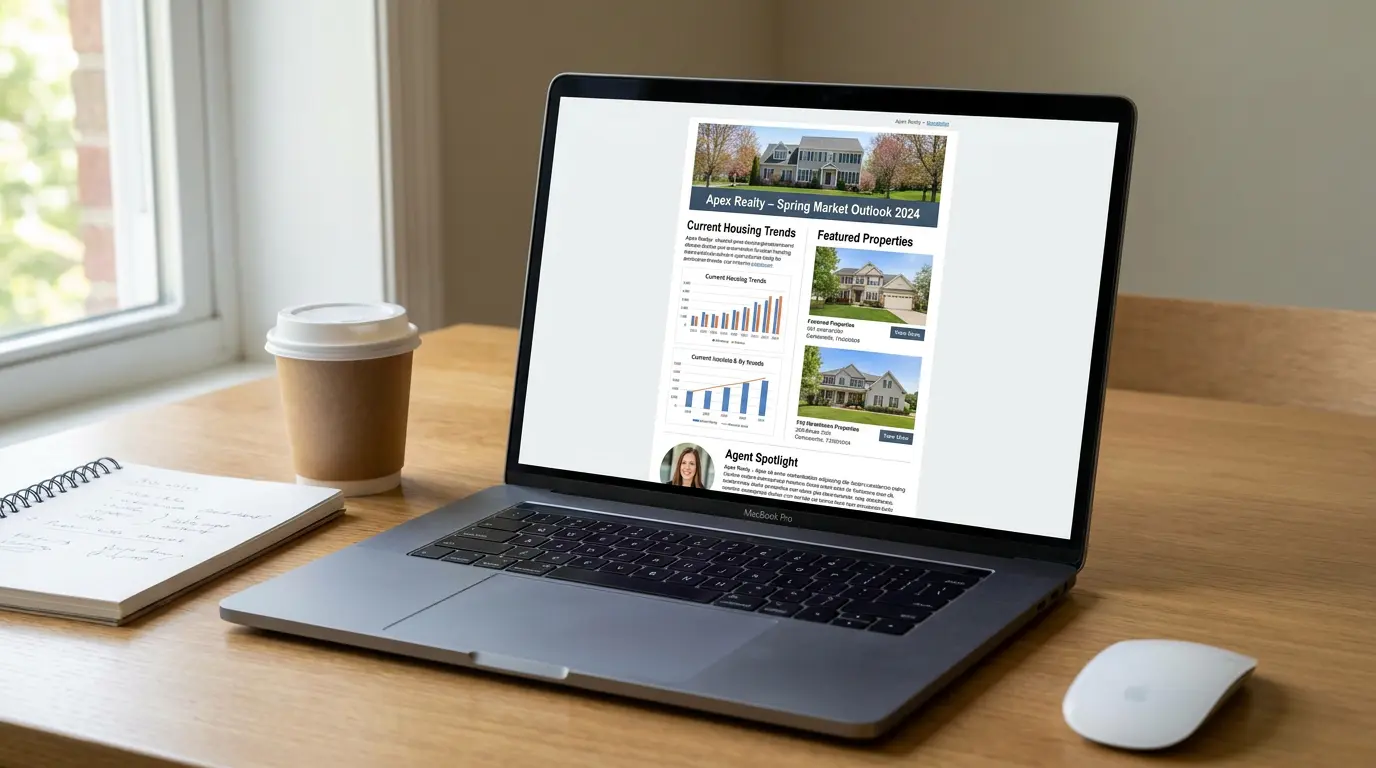
A real estate newsletter is a recurring email you send to past clients and your sphere, usually monthly, that mixes local market data, neighborhood news, and one or two listings so people remember you before they need an agent. The newsletters that actually get opened are not the ones with the prettiest template. They are the ones sent on a consistent schedule with a clear reason to open every single time.
Most agents quit newsletters within three months because writing one from scratch feels like a part-time job. This guide gives you a repeatable monthly system you can fill in under an hour, the content blocks that earn opens, the deliverability basics that keep you out of spam, and one tactic that reliably lifts click rates: adding a short video. It pairs with a wider real estate email marketing strategy, but the newsletter is the one piece you should run even if you do nothing else.
Why most real estate newsletters get ignored
The average real estate email is opened by roughly one in five recipients. Mailchimp's published email benchmarks place the real estate, design, and construction category around a 20% open rate with click rates under 2%. That sounds low until you look at what most agent newsletters contain: a wall of new listings, a stock market graphic, and a generic seasonal greeting. There is no specific reason to open it, so people don't.
The fix is not a fancier template. It is giving subscribers something they cannot get from Zillow: your read on their specific neighborhood. An agent who writes two honest sentences about why a house three streets over sold in four days will out-earn a polished stock template every time.
What to put in a real estate newsletter
Use the same five blocks every month and only change the contents. A fixed structure is what makes a newsletter sustainable, because you are filling in a template instead of inventing a format from nothing each time. Here is the system that takes under an hour once your data sources are bookmarked.
- One local market number that matters. Median sale price, average days on market, or months of inventory for one specific zip code, plus one sentence on what it means for a buyer or seller right now. Pull it from your MLS, not a national headline.
- One neighborhood story. A new coffee shop, a school rezoning, a park reopening. This is the part Zillow can never copy and the reason locals stay subscribed.
- One featured listing as a video. Not your whole inventory. One property, shown as a short video people can watch without clicking out to a portal.
- One useful answer. Respond to a real question you got that month, like whether to renovate a kitchen before listing. Keep it to a short paragraph.
- One clear next step. A single call to action: reply to this email, book a 15 minute home value call, or forward to a friend who is moving.
That is the entire newsletter. Five blocks, one screen of scrolling, sent on the same day every month.
DIY, done-for-you, or a hybrid
The search results for newsletters are full of done-for-you services that mail a generic template with your photo on it. They are easy, but the content is the same one every other agent in your area is sending, which defeats the purpose. Here is how the three common approaches compare.
| Approach | Typical cost | Local relevance | Best for |
|---|---|---|---|
| DIY from scratch | Free | High, if you do the work | Agents with time to write |
| Done-for-you service | $13 to $50+ per month | Low, the same content every agent sends | Agents who want it fully hands-off |
| Five-block system plus a listing video | $1.50 per image for the video | High, your own market read | Agents who want opens and referrals |
How often should you send a real estate newsletter
Monthly is the right default for almost every agent. It is frequent enough to stay top of mind and rare enough that you can keep quality high. Weekly works only if you have genuine weekly news, which most residential agents do not. Quarterly is too sparse; people forget who you are between sends, and your unsubscribe rate climbs because the email starts to feel like it came from a stranger.
Pick one day, the first Tuesday of the month for example, and protect it. Consistency does more for your open rate over a year than any single clever subject line.
The one tactic that lifts clicks: add a video
A static newsletter asks people to read. A newsletter with a thumbnail that looks like a video asks people to watch, and watching is a lower-effort action than reading, so more people click. For the featured-listing block, a short walkthrough video almost always out-clicks a grid of photos.
The friction has always been production. Filming and editing a listing video for a single email is not worth an agent's time. This is where an AI tool changes the math. You can turn your existing listing photos into a video instead of filming anything. Amplifiles is an AI real estate video maker that turns listing photos into a branded 1080p video in about five minutes, at $1.50 per image (one dollar and fifty cents), with voice-over and captions included. For a newsletter, that means a fresh featured-listing video every month without touching a camera.
General video tools can do this too, with more effort. Lumen5 and InVideo are built for broad marketing clips and expect you to assemble scenes and choose stock footage. Canva is excellent for the newsletter graphics themselves but is not a listing-video tool. Amplifiles is purpose-built for the real estate use case: photos in, a property video out, sized for email and social. That narrow focus is the point when your goal is one listing video a month, not a video production hobby.
How to keep your newsletter out of spam
Deliverability is the part nobody talks about, and it is why some agents send to 800 people but only 300 ever see the email. Three things matter most.
First, authenticate your domain. Set up SPF, DKIM, and DMARC records with your email platform so inbox providers trust that the email is really from you. Most platforms walk you through this in their settings. Second, keep your list clean. Remove addresses that have not opened anything in a year, because a smaller list of engaged readers lands in the inbox while a bloated list of dead addresses drags your whole sender reputation down. Third, avoid the trigger that has nothing to do with frequency. As real estate marketer Preston Guyton puts it, spam is not based on how often you send, it is based on what you send. Segment buyers, sellers, and past clients so the content stays relevant, and never send a single email that is nothing but listings.
Subject lines that earn the open
The subject line decides whether the rest of your work gets seen. Specific and local beats clever every time. "What sold in Maplewood last month" will out-open "Your March Real Estate Update" because it names a place the reader cares about and promises one concrete thing. Lead with the neighborhood or the number, keep it under about 45 characters so it is not cut off on a phone, and write the first line of the email as if it were a second subject line, because many inboxes show it as preview text.
Frequently asked questions
What should I put in a real estate newsletter?
Use five fixed blocks every month: one local market number with a plain-language takeaway, one neighborhood story, one featured listing shown as a short video, one useful answer to a question you actually got, and one clear next step. Keeping the structure constant is what makes the newsletter sustainable, because you fill in a template instead of reinventing the format each time.
How often should I send a real estate newsletter?
Monthly is the right cadence for almost every agent. It keeps you top of mind without forcing you to manufacture news, and it is sustainable over years. Send weekly only if you genuinely have weekly news, and avoid quarterly because readers forget who you are between sends.
Do real estate newsletters actually work?
Yes, when they are consistent and local. A newsletter is one of the cheapest ways to stay in front of your past clients and sphere, which is where most repeat business and referrals come from. The agents who see results are the ones who send on a reliable schedule with content people cannot get from a national portal.
What is a good open rate for a real estate newsletter?
Industry benchmarks put real estate email open rates around 20%, so anything consistently above that is healthy, and a well-segmented list of engaged past clients can reach 35% or higher. Open rates depend far more on your subject line and list hygiene than on your template design. Clean your list yearly and write specific, local subject lines to push the number up.
How do I add a video to my newsletter without filming?
Use an AI video maker that builds the video from photos you already have. Amplifiles turns listing photos into a branded 1080p video in about five minutes at $1.50 per image, with voice-over and captions, so you can drop a fresh featured-listing video into every send without filming or editing. Embed a thumbnail that links to the video, since most email clients do not autoplay video.
Final thoughts
A real estate newsletter is the cheapest referral engine you have, but only if you actually send it. The agents who win are not the ones with the best design. They are the ones who pick five blocks, one day a month, and never miss. Add one short listing video to that and you have something people look forward to opening.
We built Amplifiles because filming a video for every listing is the step most agents skip. Our platform turns listing photos into professional 1080p marketing videos in about five minutes, with voice-overs, captions, and branding, so you can add a fresh featured-listing video to every newsletter without filming or editing.
Browse real estate video examples to see what a delivered listing video looks like, or see how to use listing videos across email and social and start with your 1,200 free credits. For more channel ideas, our real estate marketing ideas guide covers what to pair with your newsletter. If your list includes rental owners, our property management marketing guide shows how a monthly market update keeps investors warm between deals.