.webp)


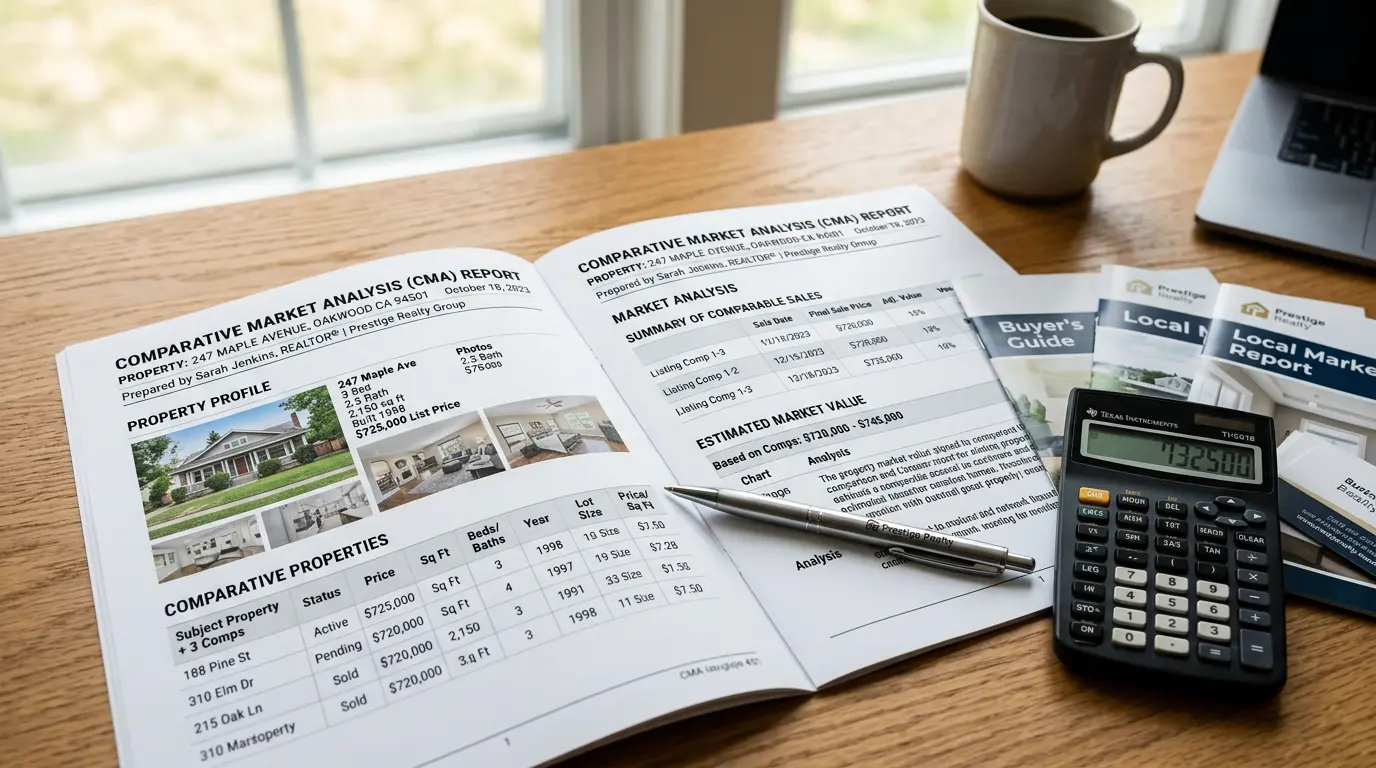
A comparative market analysis (CMA) is the report a real estate agent builds to estimate a home's market value by comparing it to recently sold, similar properties nearby. It is the single document that decides whether you price a listing to sell or watch it sit. Most guides explain what a CMA is. This one is for the agent who has to build one, defend the number to a seller, and walk out with the listing.
Get the comps right and the pricing strategy right, and the CMA does two jobs at once. It anchors a realistic price, and it becomes the most persuasive page in your real estate listing presentation. Get it wrong and you either lose the listing to an agent who priced it better, or you win it at a number that never sells.
What a comparative market analysis actually is
A CMA estimates value using the sales comparison approach: you find recently sold homes that are close to the subject property in location, size, age, and condition, then adjust their sale prices up or down for the differences. The result is a defensible price range, not a single magic number.
A CMA is not an appraisal. An appraisal is a formal valuation by a licensed appraiser, usually ordered by a lender, and it carries legal weight in a transaction. A CMA is prepared by an agent to set a competitive listing price or to guide a buyer's offer, and it is not legally binding. It is also not a Zestimate or any automated valuation model. Those tools run an algorithm over public data and never see that the kitchen was renovated or that the lot backs onto a highway. Your CMA is the human correction to the algorithm.
Sellers feel this difference the moment you show your work. The number that comes with three real, adjusted comps and a reason for each beats the number that comes from a website every time.
How to build a CMA that wins the listing
The process is five steps. The order matters, and the part most agents rush, comp selection, is the part that decides everything.
1. Document the subject property first
Before you look at a single comp, write down the subject home in detail: square footage, bedrooms and bathrooms, lot size, year built, condition, and the features that move money locally (renovated kitchen, primary suite, finished basement, garage, view, pool). This is your baseline. Every adjustment later is measured against it, so vague inputs here produce a vague price.
2. Pull the right comps, not the convenient ones
Good comps are recently sold homes that a buyer would genuinely cross-shop against the subject property. The working filter most agents use: sold within the last three to six months, within about half a mile to a mile (or the same school zone and subdivision), same property type, and within roughly 10 to 15 percent of the subject's square footage. Recent sales are the backbone because the market can move in a quarter.
Pull three buckets, not one. Sold comps tell you what buyers actually paid. Active listings tell you what you are competing against right now. Pending listings tell you where the market is heading. Expired and withdrawn listings are the most underused of all, because they show you the exact price points where the market said no. If three similar homes expired above $600,000 and two sold below it, you have just found the ceiling.
3. Adjust for the differences
No two homes are identical, so you adjust each comp's sale price to account for how it differs from the subject. If a comp has an extra bedroom the subject lacks, you subtract the local value of that bedroom from the comp's price. If the subject has a renovated kitchen the comp lacks, you add the value of that upgrade to the comp.
A concrete example. Say a comp sold for $625,000 but has one more bathroom and a finished basement the subject does not have. If a full bath is worth about $15,000 in your market and the finished basement adds about $20,000, you adjust that comp down by $35,000 to roughly $590,000 as a like-for-like comparison to the subject. Do this across three to six comps and the numbers start to cluster. That cluster is your value range.
Agents disagree on method here. Some assign specific dollar values to features, others work from an adjusted price per square foot. Both are fine. What is not fine is skipping adjustments and averaging raw sale prices, which is how a CMA ends up off by tens of thousands.
4. Set a pricing strategy, not just a price
The adjusted comps give you a range. Turning that range into a recommended list price is a strategic decision, and it is where your judgment earns the commission. Pricing at the top of the range maximizes the headline number but risks sitting on the market, and a stale listing almost always sells for less than a sharply priced one would have. Pricing slightly inside the range can trigger more showings and, in a competitive market, multiple offers that push the final price above where you would have listed it anyway.
Tie the recommendation to the data the seller can see: days on market for the comps, the spread between list and sold prices in the area, and the active competition. A price that comes with that context is a price a seller will trust.
5. Present it so it actually lands
This is the step the ranking guides ignore, and it is the one that wins listings. A CMA the seller does not understand is a CMA that does not get the signature. According to the National Association of REALTORS Profile of Home Buyers and Sellers, most sellers contact only one agent before listing, which means your presentation of the CMA is often the only one they ever see. It has to be clear and it has to be memorable.
A static PDF of comps is the floor, not the ceiling. The agents who win competitive listings increasingly walk the seller through the three strongest comps visually, then hand over a short, branded video that the seller can rewatch and forward to their spouse. That video is also the head start on marketing the listing the moment you win it. This is where Amplifiles fits: it turns listing photos into a branded 1080p walkthrough video in about five minutes, so you can build a comps walkthrough or the listing's marketing video without filming or editing. At $1.50 per image (one dollar and fifty cents per image), it costs a few dollars to turn a price recommendation into something the seller remembers.
CMA vs appraisal vs automated estimate
Sellers conflate these three constantly, and being able to draw the distinction cleanly is part of sounding like the expert in the room.
The practical takeaway for a seller: an automated estimate is a starting guess, a CMA is an informed pricing recommendation from someone who knows the street, and an appraisal is the lender's check later in the deal. All three can land on different numbers, and that is normal.
How accurate is a CMA, and what throws it off
A CMA is as accurate as its comps and the judgment behind the adjustments. In a neighborhood with steady, recent, similar sales, a well-built CMA usually lands within a few percent of the eventual sale price. Accuracy drops fast in three situations: unique properties with no real comparables, thin markets where the nearest sale is months old or streets away, and rushed analyses that skip adjustments. This is also why an inexperienced or part-time agent can produce a CMA that misses, and why your method is worth explaining out loud.
Treat the output as a range, not a guarantee. A CMA that promises a single precise figure is overselling. A CMA that says "based on these five comps, expect $585,000 to $610,000, and here is why I would list at $599,000" is doing the job honestly.
Frequently asked questions
How do I get a comparative market analysis for my home?
The most reliable CMA comes from a local real estate agent, who has access to sold-price data through the MLS and knows the micro-market. Most agents prepare one for free as part of a listing presentation. Some websites offer instant estimates, but those are automated valuations, not a true CMA, because they cannot see condition, upgrades, or location nuance.
Do real estate agents charge for a CMA?
Almost never. Agents prepare a CMA for free because it is how they earn the listing. It is the centerpiece of the listing presentation and the document that demonstrates pricing expertise, so charging for it would defeat the purpose.
Can I get a CMA for free?
Yes. A local agent will build one at no cost in exchange for the chance to win your listing. Online automated estimates are also free, but they are a rougher starting point rather than a real comparative market analysis with adjusted comps and a human pricing recommendation.
What is the difference between a CMA and an appraisal?
A CMA is an agent's estimate used to set a listing price and is not legally binding. An appraisal is a formal valuation by a licensed appraiser, typically ordered by the lender during the transaction, and it carries legal weight for financing. A CMA guides the list price; an appraisal confirms value for the loan.
How many comps should a CMA include?
Three to six strong, recent comps is the working standard. Fewer than three and the range is not well supported; many more than six and you are usually reaching for sales that are not truly comparable. Quality of comps beats quantity every time.
What is the best way to present a CMA to a seller?
Lead with three adjusted comps, give a clear price range, and tie the recommendation to days on market and active competition. Then make it memorable. A short branded video walkthrough of the comps and the recommended price, which you can build from listing photos with a tool like Amplifiles in about five minutes, is far more persuasive than a static PDF and gives the seller something to rewatch and share.
Final thoughts
A comparative market analysis is not a formality you generate before a listing appointment. It is the argument for your price and the proof of your expertise, built from carefully chosen comps, honest adjustments, and a pricing strategy the seller can follow. Win those three and the listing usually follows.
We built Amplifiles because the data is only half the job. Presenting it is the other half. Our platform turns listing photos into professional 1080p marketing videos in about five minutes, with voice-overs, captions, and branding, so the home you just priced has a marketing video ready the day you win the listing. No filming or editing required.
Browse real estate video examples to see what a delivered listing video looks like, or see how Amplifiles works for real estate agents and start with your 1,200 free credits. For more on timing the sale, read our guide on the best time to sell a home.