.webp)



Real estate video marketing in 2026 has one rule: if it doesn't earn attention in 2 seconds, it doesn't work.
The trends that matter this year aren't about flashier production or biggerbudgets. They're about speed, specificity, and systems. The agents winning listings are the ones producing hyper-local videos that answer a specific buyer's question — not cinematic montages set to royalty-free piano music.
Here are the 7 trends reshaping real estate video in 2026, based on what we're seeing across thousands of listings and the strategies agents are actually using to generate leads:
The quick version:
- AI video tools have become core infrastructure — not optional, not
experimental - Hyper-local "block-by-block" videos are the #1 organic lead generator
- Voice-guided tours outperform silent videos across every platform
- Attention-first design (hook in 2 seconds) is now mandatory
- Image quality is baseline — 89% of consumers say video quality impacts trust
Let's break each one down.
What hasn’t changed since 2025
Every trend we highlighted in 2025 are still relevant. Different video types remain the backbone of attracting attention, building trust, and explaining the property. Vertical formats still dominate discovery, and AI video tools continue to lower the barrier to producing consistent video content.
What changed is not whether these things matter, but how expected they have become.
The goal in 2026 is no longer to simply use video, but to level up how it is used. The same tools and formats now need to work harder to differentiate listings, respond to buyer and seller demand, and compete in more crowded feeds.
Here's the list of 2026:
1. Hyper-local real estate videos turn into lead generators

Hyper-local video used to mean showing the neighborhood. In 2026, it means speaking to one specific buyer in one specific place.
What changed:
- Videos focus on micro areas, not cities
- Content answers real buyer questions
- Agents show lived experience, not landmarks
Examples that work:
- What daily life looks like on this street
- Who usually buys homes in this block
- What your budget actually gets you here
These videos work because they feel specific. Buyers trust agents who clearly operate inside a small radius. Hyper-local content now pulls inbound leads instead of just supporting brand awareness.
2. Attention-first video design becomes mandatory

When it comes to video content, hooks matter more than ever. In 2026, attention is not given. It is earned. Industry shifts suggest that agents must now open with the outcome in the first two seconds to combat the high friction of modern discovery layers.
What works:
- Starting with the strongest image or scene
- A clear statement that sets context immediately
- Showing the most relevant moment first, not saving it for later
Some creators use bold statements. Others lead with the best visual. Both approaches work when they respect the viewer’s time.
If the first seconds do not answer “why should I watch this,” the video is skipped.
Agents move beyond “just sold” photos on social media
In 2026, agents are moving past simple “just sold” images and generic celebrations. The trend has shifted toward "listing storytelling" that feels like a guided experience rather than a highlight reel.
What performs better:
- Explaining how the sale actually happened
- Showing challenges that were solved
- Walking through pricing decisions, timing, or buyer demand
This shift is also highlighted in Inman’s 2026 piece on video content that converts, which points to “story of the sale” style videos as a stronger trust builder than a standard victory post.
3. Image and video enhancement becomes the expected standard
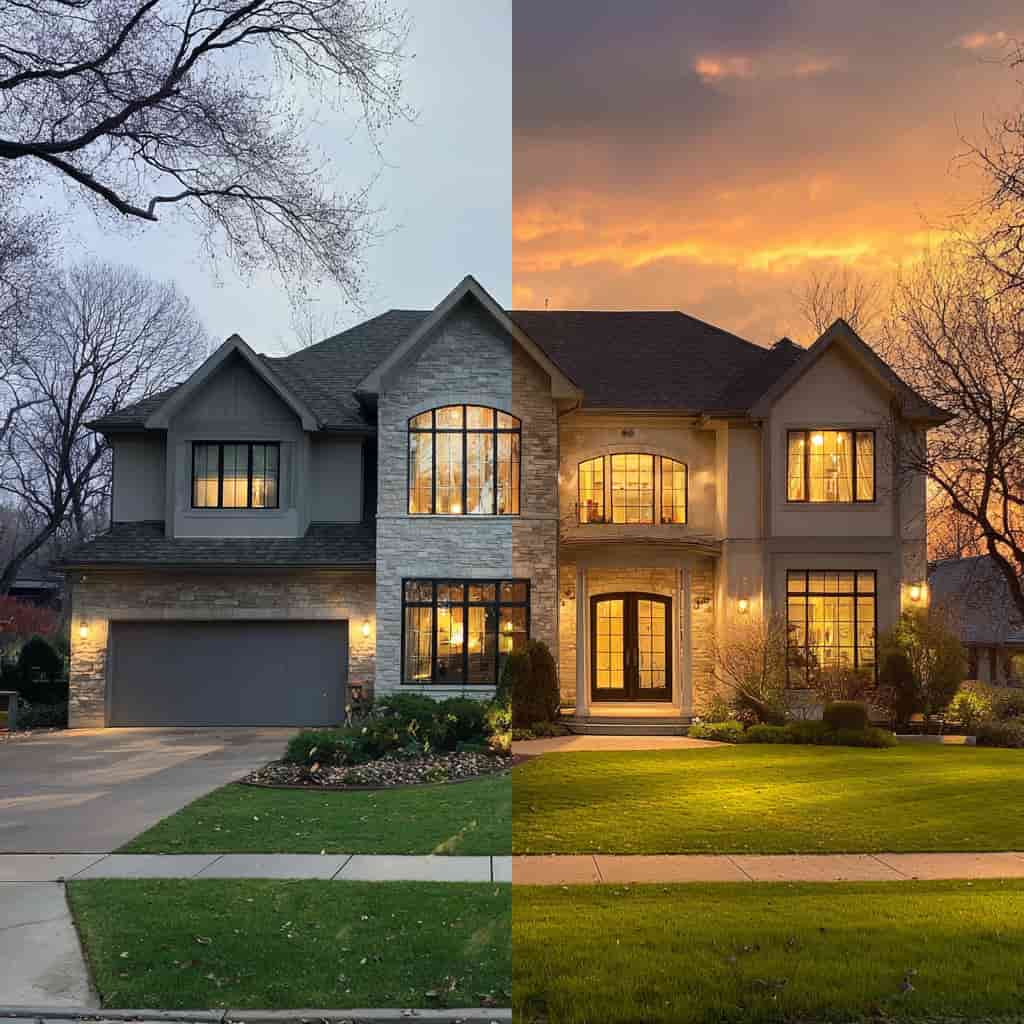
Twilight visuals were an early signal. Listings that feature a twilight "hero shot" as the main image see an average of 76% more views than those without.
In 2026, enhancement goes further. Enhanced visuals are no longer polish; they are the baseline standard.
What buyers now expect:
- Balanced lighting
- Clean colors
- Natural looking motion
- Exterior shots that feel warm and intentional
Listings with flat daylight photos feel rushed. Listings with enhanced visuals feel cared for. This is not about making homes look fake. It is about making listings feel complete.
4. AI real estate video tools become core infrastructure
.jpg)
AI did not win because it is impressive. It won because the economics broke.
In 2026:
- Every listing needs a video
- Budgets did not increase
- Timelines got shorter
Agents and photographers needed tools that fit daily workflows. AI video tools that turn photos into videos in minutes became the obvious solution.
''I looked at a few similar tools but was hesitant after reading the reviews. I expected it to look obviously AI-made, but Amplifiles wasn’t like that at all. If you didn’t know the videos were AI-generated, you’d never be able to tell."
Brandon Upright, Realtor & Amplifiles User
Agents did not adopt AI to replace creativity. They adopted it to keep up with volume. Speed matters more than perfection. Consistency matters more than one great video. AI did not win because it is impressive. It won because the economics broke.
5. Voice-over and voice cloning replace silent listing videos
Voice is one of the biggest shifts shaping real estate video right now.
What changed:
- Voice builds trust faster than text
- Buyers stay longer when guided
- Short narration outperforms long descriptions
AI voice quality is now good enough for real use. Voice cloning makes it possible to keep the same tone across all content without recording every time.
Silent videos still work for ads. For listings and agent credibility, voice wins.
6. Visual effects support attention but do not sell homes

Visual effects and AI-generated wow moments are good at one thing: grabbing attention.
You see a lot of time-lapse style videos on social media where a house appears to be built from scratch in seconds, a finished home fades in over an empty lot, or a helicopter-style movement pulls a curtain away to reveal the property.
These tricks usually require:
- Strong prompting skills
- Careful start and end frame planning
- Solid editing or AI workflow know-how
They work well for:
- Ads
- Social discovery
- Brand awareness
However, they can hurt:
- Listing clarity
- Buyer trust
- Serious purchase intent
As experts note, buyers are increasingly looking for "truth" over "beauty", favoring measurement-accurate tours over wide-angle exaggerations. These effects are not meant to explain a home; they are meant to stop the scroll. Listing videos especially benefit from clarity over spectacle. The key question is simple: what is the goal of this video?
Bonus: AI clones move from experiments toward real use
AI clones for real estate are already possible today, but the quality might still be uneven. That is changing fast. In 2026, AI clones are moving from demos and experiments toward practical use, especially for repetitive video tasks where consistency matters more than realism.
What AI clones start to enable:
- The same agent appearing across many videos without recording each time
- Consistent tone and presence across listings
- Faster production of short, informational videos
Right now, realism is the main limitation. Movements and timing can still feel slightly off but that gap is closing quickly.
AI clones will not replace agents. They will replace repetition.
Final takeaway for 2026
In 2026, real estate video marketing is no longer about standing out. It is about meeting expectations. Buyers expect video. Sellers expect video. Platforms expect video. What separates strong marketing from weak marketing is not how cinematic the video looks, but how clearly it communicates, how relevant it feels, and how fast it gets produced.
The agents, photographers, and marketers who succeed in 2026 are not chasing trends. They are building simple, repeatable video workflows that work for every listing, not just the best ones.