.webp)



Real estate farming is a geographic-focused marketing strategy where an agent becomes the go-to expert in a specific neighborhood by consistently marketing to the same 250 to 500 households over a 12 to 24 month horizon. Done right, a farm area produces a predictable stream of listing opportunities. Done wrong, it burns through thousands of dollars in postcards before producing a single client.
This guide covers how to pick a farm area, the two frameworks every farmer should know, 11 ideas that still work in 2026, and the video-first playbook that lets a new agent compete with someone who has been mailing the same street for a decade. Everything here is tactical, with real costs and a 90-day action plan. If you want the broader context, start with our video marketing guide for real estate agents and come back here for the farming-specific plays.
What is real estate farming?
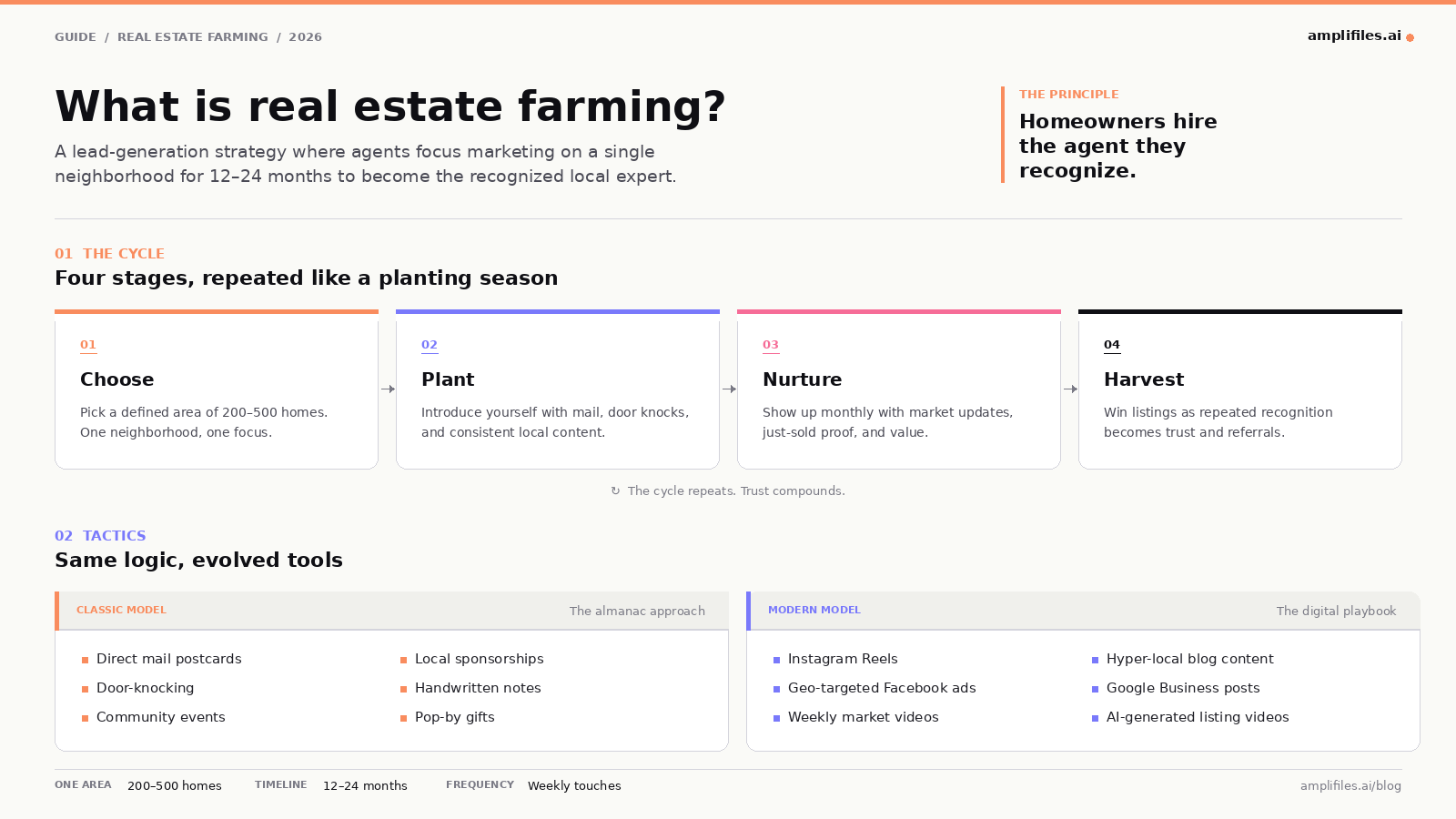
Real estate farming is a lead-generation strategy where an agent concentrates their marketing on a single geographic area, called the farm, and works that area consistently for 12 to 24 months to become the recognized local expert. The classic model uses direct mail, door-knocking, and community events. The modern model adds digital channels like Instagram Reels, Facebook ads with geo-targeting, weekly market update videos, and hyper-local content.
The underlying logic has not changed in 30 years. Homeowners hire the agent they recognize. If your face, your name, and your just-sold results show up in the same neighborhood every week for a year, you become the default call when someone decides to sell.
Farming overlaps with geographic farming and neighborhood prospecting. All three describe the same tactic. The word farming is shorthand because the activity looks like agriculture: you choose a piece of land, invest consistently over a full cycle, and harvest once the seeds you planted take root.
Does real estate farming actually work?
Yes, but not quickly. The National Association of Realtors reports that agents who dominate a geographic farm typically capture 10 to 20% of the annual transactions in their area once they hit the two-year mark. That compounds: in a 400-home farm with 6% annual turnover, that is roughly 24 listings a year, of which 2 to 5 go to the farmer.
Most agents quit before they see the first result. Farming is not a 90-day campaign. The break-even point for a well-run farm is 9 to 14 months, depending on spend and market. Agents who pull back after three mailings because "nothing happened" waste every dollar they spent.
Two things determine whether farming works for you. First, turnover rate. A farm area with less than 4% annual turnover cannot produce enough listings to justify the spend. Second, consistency. Three postcards a year is a hobby. Monthly contact across at least three channels is a strategy. See our guide on why new agents struggle with leads for the consistency trap in more detail.
How to pick a farm area
Choosing the wrong farm is the most expensive mistake in this entire playbook. These five criteria weed out 80% of bad choices.
- Size: 250 to 500 homes. Smaller than 250 and the math does not work even at high turnover. Larger than 500 and you cannot maintain consistent contact across all channels without burning out or burning cash.
- Turnover rate: 6% or higher annually. Pull the last three years of sales from your MLS and divide by total homes. Below 4% the farm cannot generate enough listings to justify the spend. The sweet spot is 6 to 9%.
- Competition: no dominant agent. If one agent already owns 30% or more of the listings, walk away. You will spend two years denting their brand. Pick a fragmented area where the top agent has under 15% share.
- Average sale price: high enough to fund the spend. A 3% commission on a $400K home is $12K. After your split that is roughly $6K to fund another year of farming. In a $200K market the math is twice as hard.
- Personal connection: you know the area. You live there, your kids go to school there, you have past clients there, or you genuinely care about the community. Without a real connection your content sounds generic and your door-knocks feel transactional.
Run all five checks before you send a single mailer. A good farm is worth 10 years of business. A bad one is worth nothing.
The two frameworks every farmer should know
Two mental models show up in almost every top-producing farmer's playbook. Learn both.
The 3-3-3 rule
The 3-3-3 rule in real estate farming means reaching your farm area three times a month across three different channels (mail, digital, in-person) for at least three months before you expect measurable results. It is a minimum viable dose. Agents who drop below it are essentially paying to be forgotten.
A simple 3-3-3 month looks like this: one postcard, one Instagram Reel geo-tagged to the area, and one door-knock round or community event appearance. Three touches. Three channels. Repeat monthly for at least a quarter.
The FARM framework
FARM stands for Focus, Area, Research, Marketing. Focus on one geography at a time. Define the Area precisely (street boundaries, not a general neighborhood name). Research turnover, demographics, and current market share before committing. Then Market consistently with a plan you can execute for 18 months without burning out.
The common failure mode is skipping the R. Agents pick an area based on vibes, then wonder why their mailers underperform. An hour of research at the start saves 10 months of wasted spend.
11 real estate farming ideas that work in 2026
Half the ideas below are traditional. Half are digital or video-first. The best farmers mix both. Pick two or three that match your style and budget, then run them consistently for six months before adding more.
- Monthly market update postcard. One stat-driven postcard per month showing average sale price, days on market, and listing-to-sale ratio for the farm specifically. Generic postcards get tossed; data postcards get pinned to fridges.
- Just-sold and just-listed Reels. Within 48 hours of every comparable sale, post a 20-second Reel showing the home, sale price, and a one-line takeaway ("This 3-bed sold $40K over ask in 6 days"). Geo-tag the post and boost it with $30 to $50 to neighbors within a 1-mile radius.
- Quarterly door-knock rounds. Knock 50 to 100 homes per quarter with a printed market sheet, not a sales pitch. Script: "Hi, I track every sale in this neighborhood. Want a copy of last quarter's data?" Hand off the sheet, ask one question, leave.
- Hyper-local Instagram and TikTok content. Weekly content tied to the area: best brunch spots, school district updates, new construction, park renovations, restaurant openings. You become the neighborhood account, not just an agent account.
- Neighborhood email newsletter. Monthly send to an opt-in list of homeowners. Three sections: market data, two recent sales with photos, and one community story. Build the list with a simple "Want monthly market updates for [neighborhood]?" landing page.
- Quarterly pop-by gifts. Inexpensive seasonal items (spring seed packets, fall pumpkins, holiday cocoa kits) dropped at past clients and warm leads in the farm. $4 to $7 per drop, four times a year. Highest recall per dollar of any tactic.
- Geo-targeted Facebook and Instagram ads. $200 to $400 monthly ad budget targeted to a 1-mile radius around the farm. Rotate three creatives: a just-sold Reel, a market update graphic, and a "thinking about selling?" CTA.
- Community event sponsorship. One bigger play per year: little league team, school auction, neighborhood 5K, food truck night. $500 to $2,000. The point is not the impressions; it is the conversation at the listing appointment ("oh, you sponsored our team last year").
- Quarterly homeowner workshops. Host a free 30-minute event on a relevant topic: "What your home is worth in 2026," "Downsizing without losing money," "How to prep for a spring sale." Hold it at a local cafe or library. Eight attendees beats a hundred postcards.
- Google Business Profile tied to the farm. Set your service area to the specific neighborhood and ask every closed client to leave a review mentioning the area by name. Geographic reviews compound for local search.
- Long-life yard signs. Negotiate with sellers to keep your "Just Sold" sign up for two weeks instead of a few days. In a 400-home farm with 6% turnover that is roughly two extra signs per month visible to neighbors.
The video-first farming playbook
Here is what most farming guides miss. The economics of farming have shifted. Postcards cost $0.60 to $1.20 per household per mailing, and they compete with a mailbox full of similar junk. A 20-second video posted to Instagram and run as a local ad reaches the same household for a fraction of the cost, gets passed along, and keeps working long after the postcard hits the recycling bin.
Video-based farming costs roughly $1.50 per listing asset when generated with AI from photos, compared to $0.60 to $1.20 per household for a single postcard mailing. And the video compounds on social algorithms instead of ending up in the trash. A just-sold Reel in a 400-home farm area will typically reach 800 to 2,000 neighbors when boosted with a $50 ad budget.
The four video formats that do the heavy lifting in a modern farm:
- Just-sold and just-listed clips. 15 to 25 seconds, sale price on screen, one short voiceover line. The single highest-converting format because it doubles as social proof. Run one within 48 hours of every comparable sale.
- Monthly market update. 60 to 90 seconds. You on camera with three stats: median sale price, days on market, and listing-to-sale ratio for the neighborhood. Post the same script as a Reel, a TikTok, and a YouTube Short.
- Neighborhood spotlight. 30 to 60 seconds covering one local thing: a new restaurant, a school renovation, the best park for dogs, a hidden trail. No real estate pitch. The goal is to become the account homeowners follow because they actually live there.
- Client story or testimonial. 45 to 90 seconds with a past client at the closed home, walking through what they liked about the process. One per quarter. These convert at listing appointments more than any other content type.
The compounding effect matters. A postcard is one-and-done. A video keeps appearing in feeds, gets shared to family group chats, and builds a content library that doubles as proof when you walk into a listing appointment. See what finished listing videos look like on our real estate video examples page.
A 90-day farming plan
Most farming fails in execution, not strategy. Here is a realistic first 90 days that does not require quitting your current pipeline.
Month 1, Setup. Pick your farm (run all five criteria). Pull a mailing list from the county. Build an Instagram account or content pillar dedicated to the area. Create a branded just-sold and just-listed video template. Set up a Facebook ad account with geo-targeting for the farm boundary. Time: 8 to 12 hours total.
Month 2, First contact. Week 1: mail the first postcard with a simple introduction and a market data sheet. Week 2: post your first just-sold or just-listed video to Instagram, boosted with a $50 ad. Week 3: door-knock 50 houses with the market data sheet. Week 4: send your first neighborhood email newsletter. Budget: roughly $400 to $700 depending on farm size.
Month 3, Rhythm. Repeat the 3-3-3 cadence from month 2. Add one new element: a small community touch (sponsor a local event, attend an HOA meeting, or drop off pop-by gifts). Track every lead source. By the end of month 3 you should have name recognition in the farm, two or three warm leads, and a clear read on which channels are converting.
If month 3 produces zero warm leads, do not panic and do not quit. The 9 to 14 month break-even is real. What you are looking for is rising engagement: higher Instagram reach, more replies to emails, more people saying "I saw your postcard."
What real estate farming actually costs
Most farming guides give vague numbers. Here are real ones for a 400-home farm run monthly.
Realistic all-in monthly spend for a 3-3-3 cadence: $700 to $1,400 depending on whether you lean postcards-first or video-first. A single 3% listing commission on a $400,000 home pays back 8 to 17 months of farming spend, which is why farming works when you stay the course.
Common mistakes that kill a farm
Almost every farming failure is one of these six.
- Quitting before month 9. The break-even is 9 to 14 months. Agents who pull back after three mailings because "nothing happened" waste 100% of the spend, not 30%. Either commit to a year or do not start.
- Sending postcards with no data. A headshot and a generic "thinking of selling?" line gets thrown out in 4 seconds. Postcards that include three real stats from the neighborhood get kept. If your mailer would work in any zip code, it will not work in any zip code.
- Picking a farm with no real turnover. Vibes are not a substitute for an MLS pull. If the area sells 12 homes a year and you are competing with two established agents, you are mailing into a market that cannot pay you back.
- Spreading thin across multiple neighborhoods. Two half-farmed areas always lose to one fully-farmed area. Pick one farm. Stay there for 18 months before considering a second.
- Inconsistent branding across channels. The postcard says one thing, the Instagram bio says another, the email signature uses a different headshot. Homeowners need to see the same face, name, and color in every channel for recognition to build.
- No follow-up system for inbound calls. The whole point of farming is generating warm inquiries. If those inquiries land in a personal phone with no CRM, no callback rule, and no email sequence, you spent a year filling a leaky bucket. Set up the system before month 1, not after the first lead.
Frequently asked questions
How long does it take for real estate farming to work?
Expect 9 to 14 months before farming produces a consistent pipeline. Some agents see a first listing at month 3 or 4 from a referral, but the flywheel (where the farm produces multiple listings per quarter without you pushing hard) requires 12 to 24 months of consistent contact. Plan your budget for a full year of spending with no revenue attribution.
How much should I spend on real estate farming per month?
A 400-home farm run at the 3-3-3 cadence costs roughly $700 to $1,400 per month, depending on channel mix. Postcards and mailers are the biggest variable cost. Adding video and digital ads increases reach dramatically without adding much to the budget, because AI tools like Amplifiles produce listing and just-sold videos for $1.50 per image (about $13.50 for a typical 9-photo video) instead of the $500 to $1,500 a videographer charges.
What is the 3-3-3 rule in real estate farming?
The 3-3-3 rule in real estate farming means reaching your farm area three times a month across three different channels for at least three months before you expect measurable results. A typical 3-3-3 month uses one direct mail piece, one digital or social media touch, and one in-person activity like door-knocking or a community event. It is the minimum viable marketing dose for a farm.
How do I pick the right farm area?
Five criteria: size (250 to 500 homes), turnover rate (6% or higher annually), competition (avoid areas where one agent already dominates), average sale price (higher prices give you more marketing runway per transaction), and personal connection (you live there, shop there, or have past clients there). All five matter. Skip any one and you are gambling with a year of spend.
Does video farming really outperform postcards?
In reach per dollar, yes. A $50 boosted just-sold Reel typically reaches 800 to 2,000 local households in a 1-mile radius, versus 400 for a postcard mailing. Video also compounds: one Reel keeps generating impressions for weeks, while a postcard works for one day. That said, video does not replace postcards, it multiplies them. Homeowners who receive the same message across mail, Instagram, and Facebook in the same month are far more likely to remember your name than those who see one channel alone.
Final thoughts
Real estate farming still works in 2026, and the agents winning at it are combining traditional direct mail with cheap, high-leverage video. The math is simple: pick a farm with real turnover, commit for a year, hit the 3-3-3 cadence, and use video to multiply every dollar you spend on postcards. New agents who think they cannot compete with the long-time farmer in their area are wrong. The long-time farmer is not running just-sold Reels. You can.
We built Amplifiles because the cost and time of producing listing video has been the bottleneck that kept most agents from farming with video. Our platform turns listing photos into professional 1080p marketing videos in about 5 minutes at $1.50 per image, with voice-overs, captions, and branding. No filming or editing required.
Browse real estate video examples to see what a finished just-sold video looks like before you create one. Or jump straight to how Amplifiles works for real estate agents and start with your 1,200 free credits, which is enough to produce your first just-sold or neighborhood tour video this week.